
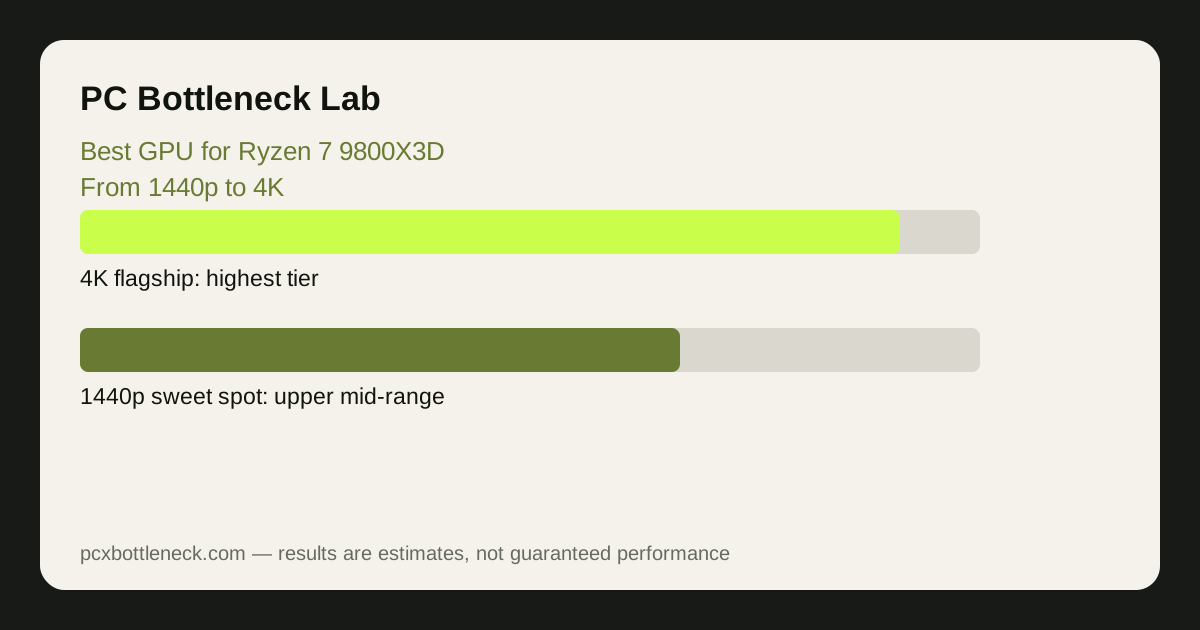
The 5 picks
- RTX 5070 — the 1440p sweet spot: the balanced entry for this CPU, ideal for 1440p high-refresh gaming. The 9800X3D keeps it fed even in CPU-heavy scenes, and the pairing leaves budget for a better monitor. The pick when 1440p is home. See the RTX 5070 page and the Ryzen 7 9800X3D page.
- RTX 5070 Ti — the 1440p ultra and light 4K step: a clear step up for maxed-out 1440p settings and the first card here that is genuinely comfortable at 4K in many games. The pick when you want 1440p without compromises. See the RTX 5070 Ti page.
- RX 9070 XT — the AMD alternative: strong raster performance and generous VRAM, suiting 1440p and 4K players who prefer AMD or find it better value where they shop. The pick when raw performance per dollar matters more than ray tracing. See the RX 9070 XT page.
- RTX 5080 — the 4K workhorse: a high-end card that finally gives the 9800X3D something to stretch against at 4K, with strong ray tracing and upscaling support. The pick for a dedicated 4K monitor. See the RTX 5080 page.
- RTX 5090 — the no-compromise flagship: the fastest consumer card, and the only one that can still be GPU-limited at 4K in the heaviest games. The pick when budget is not the constraint and the monitor is 4K high-refresh. See the RTX 5090 page.
Run any pairing through Bottleneck Calculator, and compare the 5070 options in RTX 5070 Ti vs 5070.
Which card for which monitor
| Graphics card | Resolution sweet spot | What the 9800X3D adds | Watch out for |
|---|---|---|---|
| RTX 5070 | 1440p high-refresh | Keeps the card fed in CPU-heavy scenes | 12 GB VRAM in the heaviest 4K games |
| RTX 5070 Ti | 1440p ultra, light 4K | Smooth 1% lows at max settings | Needs a solid power supply |
| RX 9070 XT | 1440p and 4K | More VRAM headroom for textures | Ray tracing trails Nvidia at this tier |
| RTX 5080 | 4K | High-end ray tracing and upscaling | High power draw and price |
| RTX 5090 | 4K high-refresh | The fastest card this CPU can feed | Very high power draw; check PSU and case |
Why the monitor decides, not the CPU
With a mid-range CPU, the card choice is a negotiation between two limits. With the 9800X3D, that negotiation disappears: the CPU is fast enough that the graphics card is the limit at every resolution, so the only question is how much GPU performance your monitor can actually show.
A 1080p 60 Hz monitor wastes every card on this list — the CPU and GPU will both idle, capped by the screen. A 1440p high-refresh monitor is where the 5070 and 5070 Ti shine. A 4K monitor is where the 5080 and 5090 earn their price, because only there does the extra GPU power turn into visible frames.
That also means the cheapest sensible card for this CPU is the one that matches your screen, not the most expensive one you can afford. A 5070 on a 1440p monitor is a better system than a 5090 on a 1080p monitor, by a wide margin.
Which one should you buy?
For 1440p, buy the RTX 5070 or 5070 Ti; for 4K, the RTX 5080, or the 5090 if the budget allows and the monitor is 4K high-refresh. The RX 9070 XT is the alternative when its value or VRAM suits your games better.
If you are still choosing the CPU itself, best CPU for RTX 5070 covers the other direction, and the AM5 upgrade path to the 9800X3D covers getting here from a cheaper chip.
Limitation: balance is estimated by resolution and monitor, not measured on your system. No prices or exact frame rates are claimed here; check current pricing, power-supply needs and your own games before buying.
Frequently asked questions
Is the RTX 5070 enough for a Ryzen 7 9800X3D?
Yes, at 1440p it is a well-matched pairing — the CPU keeps the card fed and the system is balanced. The 9800X3D can feed much stronger cards, but 'can feed' is not 'needs': at 1440p the 5070 is the sensible match, and a stronger card only pays off on a higher-resolution monitor.
Will any GPU bottleneck with the 9800X3D?
At 1080p, a very strong card can still be held back in the lightest esports games, where frame rates are so high that even this CPU sets the pace. At 1440p and 4K, the GPU is the limit in nearly all games, which is the healthy balance — the card is being fully used.
Do I need a 4K monitor to justify a 9800X3D and RTX 5080?
For the 5080, a 4K or ultrawide high-refresh monitor is where it earns its price. On a 1440p monitor the pairing still works beautifully, but a 5070 Ti would give nearly the same visible result for less money.
Is the RX 9070 XT a good match for the 9800X3D?
Yes, especially for 1440p and 4K rasterised gaming, where its VRAM and raw speed suit texture-heavy games. It trails Nvidia's cards in ray tracing at this tier, so the choice depends on whether your games use ray tracing heavily.
What power supply do I need for these cards?
It rises steeply with the tier: the 5070 is modest, while the 5080 and especially the 5090 need a high-wattage, high-quality supply with the right connectors. Check the manufacturer's recommended wattage for the exact card, add headroom, and replace the supply before the card if it is close to its limit.