
The PC Bottleneck Lab Bottleneck Index Q1: what it is
The Bottleneck Index is a single quarterly summary of how balanced the most common CPU and GPU pairings are. Instead of asking about one pair, it asks about the whole market: of the pairings builders actually use, how many are balanced, how many are held back by the processor, and how many by the graphics card? The Index turns that question into a number that can be tracked over time — rising when pairings get more balanced, falling when they get less so.
It is a summary, not a verdict on your PC. Your pairing may be perfectly balanced while the Index falls, because a new graphics card launch has made many builders' pairings CPU-limited overnight. The Index describes the market; the calculator describes your machine. Both are useful, and neither replaces the other.
The Index is published quarterly because the market moves quarterly: new parts launch, prices shift, and builders change what they buy. A monthly number would mostly measure noise; a yearly number would miss the launches that matter. Quarterly is the pace at which the picture actually changes.
How the Bottleneck Index is built
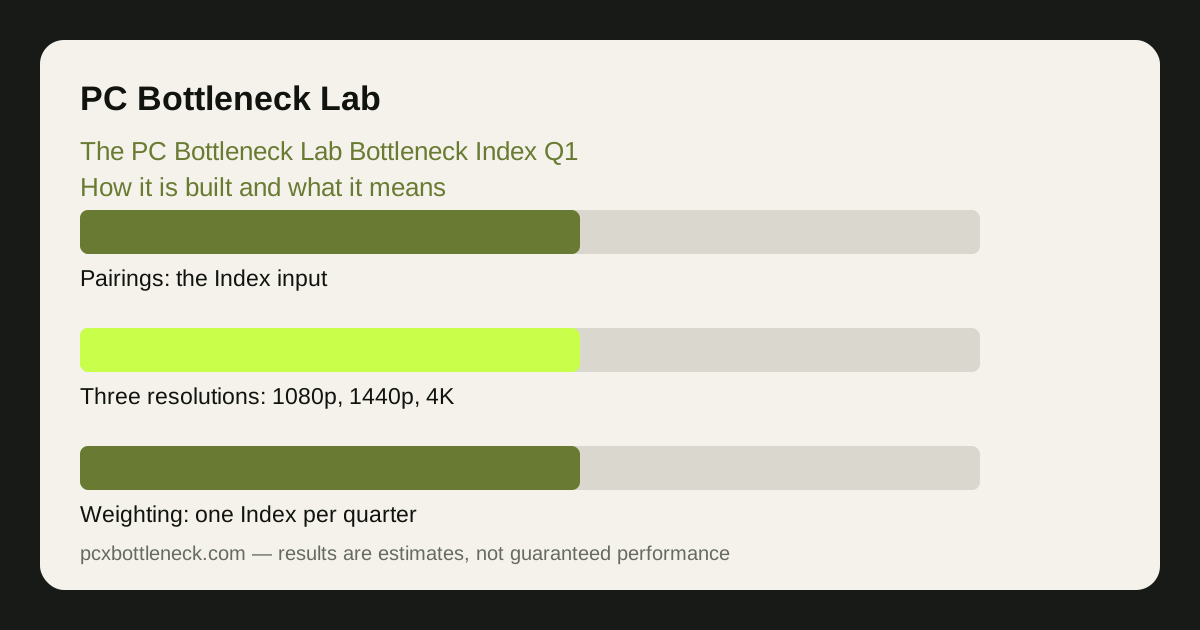
The Index is built from a fixed set of pairings — the most commonly used CPU and GPU combinations, chosen from the pairings builders actually check, not from a theoretical list. The set is fixed for the quarter, so that the Index measures a change in balance, not a change in which pairings were counted. When the set changes, the change is recorded and the previous quarter is restated on the new set, so the quarters stay comparable.
Each pairing is assessed at three resolutions — 1080p, 1440p and 4K — because a pairing's balance changes with resolution. A pair that is CPU-limited at 1080p may be balanced at 4K, and the Index must capture both, not average them away silently. The assessment for each pairing and resolution comes from the same dataset and ranges described in how we built our dataset.
The three resolutions are then combined into one Index value using a weighting approach that is fixed in advance and published with the Index: each resolution contributes according to how common it is among builders, rather than equally, so that the resolution most people actually play at counts most. The weighting is a design choice, not a measurement, and it will be stated plainly when the first values are published — including what the Index would look like under a different weighting, so readers can judge the choice.
What the Index can say — and what it cannot
The Index can say whether pairings, in general, are getting more or less balanced over time, and whether the limit is moving toward the processor or the graphics card. That is useful for builders deciding when to upgrade, and for anyone watching how new launches change the market. A rising Index after a processor launch, for example, would suggest the new processors are relieving CPU limits across common pairings.
It cannot say whether your pairing is balanced — that is the calculator's job, at your resolution and in your games. It cannot say which part you should buy, because the Index is an average over many pairings, and your pairing is one of them. And it cannot say anything about a pairing outside its fixed set: a rare or brand-new combination is not in the Index until the set is updated.
| Question | Can the Index answer it? | What answers it instead |
|---|---|---|
| Are pairings getting more balanced? | Yes — that is what it is for | The quarterly Index value and its change |
| Is the limit moving to CPU or GPU? | Yes, in general | The split of CPU-limited vs GPU-limited pairings |
| Is my pairing balanced? | No — it is an average | The calculator, at your resolution |
| Which part should I buy? | No | Your pairing, budget and games |
| What about a brand-new pairing? | Not until the set updates | The calculator and fresh benchmarks |
It also cannot be read as a precise measurement of anything physical. The Index is a constructed summary of ranges, and its value depends on the pairings chosen and the weighting used. Two reasonable Index designs could give different numbers for the same quarter — which is why the design is published with the number.
Q1 status: what is ready, and what is not
The method described above is ready: the pairing set, the three resolutions and the weighting approach are fixed. What is not ready is the Q1 value itself. The Q1 index values are not published yet, and no numbers are claimed in this article — not a value, not a direction, not a ranking of pairings. Any article or post that quotes a Q1 Index number today is not quoting us.
The reason is the same as for the accuracy test: the underlying assessments are still being completed and checked. Publishing a number before its inputs are ready would be guessing with a chart attached. The first published Index will arrive with its inputs, its weighting and its pairing set, so that the number can be checked — and with the previous quarter restated on the same basis if the set has changed.
How to use the Index when it arrives
When the first Index is published, use it the way you would use any market summary: as context, not as a shopping list. If the Index is falling and the limit is moving to the processor, that is a reason to check whether your own pairing is CPU-limited — not a reason to buy a processor. Check your own machine first, with the PC bottleneck calculator and the self-test in is my CPU bottlenecking my GPU.
And keep the Index in its place. It is one summary among several — the calculator, the accuracy test and the dataset all answer different questions. The Index tells you about the market; the calculator tells you about your PC. You need both, and neither is a substitute for testing your own games.
Limitation: the Index is a constructed summary, not a physical measurement: its value will depend on the pairing set and the weighting chosen, and Q1 values are not published yet. No Index number is claimed in this article, and no conclusion about Q1 should be drawn from it.
Frequently asked questions
What does the Bottleneck Index actually measure?
A quarterly summary of how balanced the most common CPU and GPU pairings are — how many are balanced, how many are CPU-limited and how many are GPU-limited. It describes the market as a whole, not any single PC.
Are the Q1 Index values published?
No. Q1 index values are not published yet and no numbers are claimed in this article. The method — pairings, resolutions and weighting — is fixed and published here; the values will follow when the underlying assessments are complete.
How is the Index built?
From a fixed set of commonly used pairings, each assessed at 1080p, 1440p and 4K, combined into one quarterly value using a weighting approach fixed in advance. The pairing set, weighting and inputs will be published with the first values.
Can the Index tell me if my PC is balanced?
No. The Index is an average over many pairings; your PC needs the calculator at your resolution and in your games. The Index gives market context, not a verdict on one machine.
Why publish the method before the numbers?
So the numbers can be checked when they arrive. Publishing the pairing set, resolutions and weighting first means no input can be quietly changed to flatter a result — and it lets readers judge the design before they judge the value.