
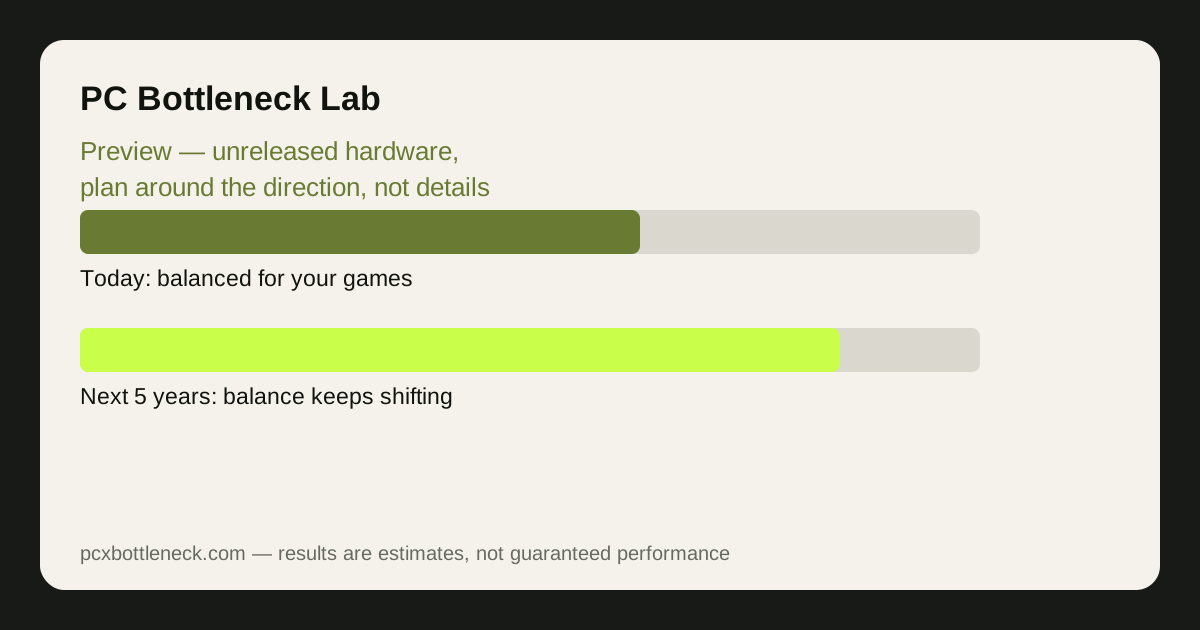
Why CPU-GPU balance shifts with every generation
CPU-GPU balance is not a fixed property of a build; it is a moving target that shifts every time a new generation arrives. A pair that is balanced today can become CPU-limited tomorrow, not because the CPU got slower, but because a new graphics card can render frames faster than the old CPU can prepare them. The reverse happens too: a new CPU can lift the frame-rate ceiling so far that a graphics card which was once the limit becomes the new bottleneck at high resolutions.
The next five years are likely to follow the same pattern, with three unreleased generations at the centre of it: AMD's Zen 6 CPUs, Intel's Nova Lake CPUs, and NVIDIA's RTX 50 Super graphics cards. All three are previews as of November 2026 — none has final published specifications, prices or launch dates from its maker — so this article plans around the direction of travel, not around details that do not exist yet. For the launch-season previews behind this piece, see the RTX 50 Super preview, the Zen 6 preview and the Nova Lake preview.
What Zen 6, Nova Lake and RTX 50 Super could mean for balance
| Preview generation | What it could shift | Who should care most |
|---|---|---|
| Zen 6 (AMD CPUs, preview) | The CPU frame-rate ceiling, especially in CPU-bound games | High-refresh and simulation players |
| Nova Lake (Intel CPUs, preview) | The CPU ceiling, plus a possible new socket and platform | Intel builders planning a platform change |
| RTX 50 Super (NVIDIA GPUs, preview) | The GPU ceiling at 1440p and 4K, and VRAM headroom | High-resolution and ray-tracing players |
| Both CPU generations together | Competition on CPU performance and price | Every builder, through better value |
| All three over five years | The balance point moving toward the GPU at high resolutions | Builders buying a card to keep for years |
Zen 6, as a preview, is expected to continue AMD's pattern of raising CPU performance on the AM5 platform, which would lift the frame-rate ceiling in CPU-bound games — esports titles, simulations and strategy games — and make high-refresh monitors easier to feed. If it stays on AM5, existing owners could upgrade the CPU without changing the motherboard, which is the cheapest kind of balance fix there is.
Nova Lake, as a preview, is expected to be Intel's next major desktop architecture, and it may arrive with a new socket — which would mean a platform change, not a drop-in upgrade, for existing Intel owners. That matters for planning: a builder choosing Intel today should assume the next generation may need a new motherboard, and should not count on a cheap CPU-only upgrade path.
RTX 50 Super, as a preview, is expected to sit above the current RTX 50 series, which would raise the GPU ceiling at 1440p and 4K and possibly add VRAM headroom. That would deepen the GPU limit at high resolutions for anyone who buys one, and it would make the CPU's job easier by comparison — a strong new card paired with an older CPU is the classic recipe for a CPU limit at 1080p, so the pairing matters more than the card alone.
The patterns that will matter more than any single launch
Three patterns will matter more than any single launch over the next five years. The first is upscaling: DLSS, FSR and frame generation are shifting work away from raw rendering, which means the GPU's raw speed matters less and the CPU's frame-preparation speed matters more in some games. A card that leans on frame generation still needs the CPU to prepare the base frames, so a weak CPU can cap even a strong card — see whether upscaling fixes or hides a CPU bottleneck.
The second pattern is memory: VRAM requirements keep climbing as games use larger textures, and system RAM speeds keep rising, so the memory headroom you buy today decides how long your build stays comfortable. A card with generous VRAM and a system with 32GB of RAM are hedges against the next five years of game requirements, not luxuries.
How to build today so the next five years do not trap you
Build for the upgrade path, not just for today. Choose a platform with a plausible CPU upgrade route — AM5 has one if Zen 6 stays on the socket; Intel's next socket is uncertain, so buy the CPU you need now rather than counting on a later drop-in upgrade. Choose a power supply with headroom above today's needs, so a stronger card in two years does not force a power-supply replacement as well. Check the wattage properly with our PSU sizing guide.
- Buy the platform, not just the part: a socket with an upgrade path is worth real money.
- Leave power and cooling headroom: the next card will want both.
- Buy VRAM and RAM generously: memory headroom ages better than clock speed.
- Re-check balance at each launch: run the new pair through the PC bottleneck calculator before buying.
Limitation: Zen 6, Nova Lake and RTX 50 Super are unreleased as of November 2026. No specifications, prices, launch dates or performance figures in this article are presented as fact, because none have been finally published — everything about them here is a preview and a planning judgement, and it should be re-checked against the makers' announcements before any purchase decision.
Frequently asked questions
When will Zen 6, Nova Lake and RTX 50 Super be released?
No final launch dates have been published by AMD, Intel or NVIDIA as of November 2026.
Should I wait for Zen 6 or Nova Lake before building a PC?
Usually not, unless your current PC still plays your games acceptably.
Will RTX 50 Super make my current GPU obsolete?
No. A new graphics card does not slow down the card you already own. It raises the ceiling for new buyers, and it may lower prices on current cards — but your card will keep playing the same games at the same settings it plays today.
Which matters more over five years, CPU or GPU?
It depends on your resolution. At 1080p high-refresh, the CPU ceiling matters more over time; at 4K, the GPU ceiling matters more. At 1440p, both matter. The balance shifts with each generation, so re-check your pair at each launch rather than assuming today's balance will hold.
How do I future-proof a PC build?
You cannot future-proof it completely, but you can build for the upgrade path: a socket with a plausible CPU upgrade route, a power supply with headroom, generous VRAM and 32GB of RAM, and a case with real airflow.