
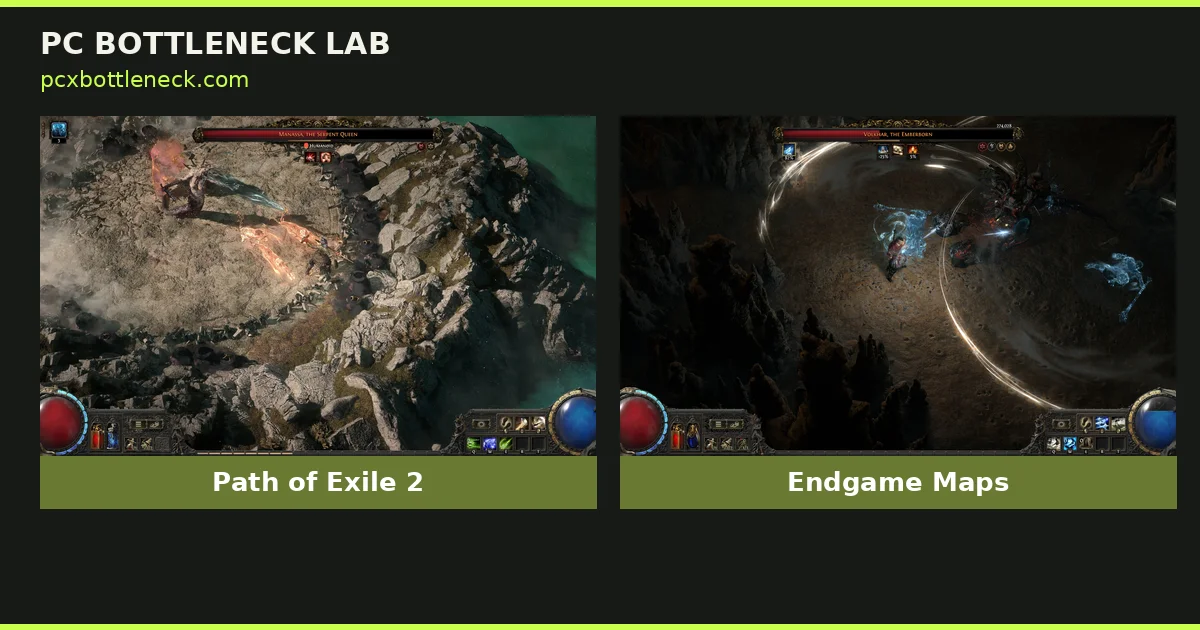
Key takeaways
- Path of Exile 2 1.0 launches on 11 Dec 2026 as a free-to-play game on PC, PS5, and Xbox Series X|S.
- The official recommended spec is a Core i5-10500 or Ryzen 5 3700X with an RTX 2060 and 16GB of RAM.
- Endgame maps are CPU-heavy, since dozens of enemies, projectiles, and effects hit at once.
- A modern six-core CPU and an RTX 4060-class card are the balanced pick for smooth endgame maps.
- The game needs 100GB of storage, and the official spec recommends an SSD.
Path of Exile 2 best CPU GPU for endgame maps: the short answer
The balanced pick for endgame maps is a modern six-core CPU, such as a Ryzen 5 7600X or Core i5-12400F. Pair it with an RTX 4060-class card and 16GB of RAM. The official recommended spec, an i5-10500 with an RTX 2060, clears the campaign, yet it falls short when a map fills with monsters and effects. The CPU matters more than the GPU in the endgame, since the game must track every enemy, projectile, and ground effect at once. If you play mostly solo and clear maps slowly, the recommended spec is enough. If you run dense maps, group play, or juiced Atlas content, the stronger CPU is the part to buy. Check your current pair with the pc bottleneck calculator before you spend.
| Tier | CPU | GPU | RAM | For whom |
|---|---|---|---|---|
| Minimum (campaign only) | Core i7-7700 / Ryzen 5 2500X | GTX 960 3GB / RX 470 | 8GB | Trying the game, low settings |
| Recommended (official) | Core i5-10500 / Ryzen 5 3700X | RTX 2060 / RX 5600 XT | 16GB | Campaign and light mapping |
| Balanced (our pick) | Ryzen 5 7600X / Core i5-12400F | RTX 4060 / RX 7600 | 16GB | Smooth endgame maps |
| High-end (dense maps) | Ryzen 7 9800X3D / Core i7-14700K | RTX 5070 / RX 9070 | 32GB | Juiced maps, group play |
The minimum and recommended rows are the official Steam specs, checked 16 Nov 2026. The balanced and high-end rows are our recommendations for endgame maps, not official specs and not measured benchmarks.
What 1.0 changes on 11 December 2026
Path of Exile 2 leaves early access on 11 Dec 2026 in Pacific time. It becomes free to play on PC, PlayStation 5, and Xbox Series X|S. Grinding Gear Games announced the date at ExileCon on 6 Nov 2026. The news came in a Steam post titled Path of Exile 2 Full Release on December 11 PST. The full release adds Acts 5 and 6, which complete the six-act campaign with 24 new areas and 18 new unique bosses. It also adds the Duelist and the Shadow as playable classes, and a new Challenge League called Conquerors of Wraeclast, with its own endgame storyline. Early access began on 6 Dec 2024 with a $29.99 Supporter Pack. Early access characters move to a permanent league, while the new 1.0 league starts fresh.
The official PC specs have not changed for 1.0, and they are the only official specs published. The minimum tier needs Windows 10, an i7-7700 or Ryzen 5 2500X, 8GB of RAM, and a GTX 960 with 3GB of VRAM. The recommended tier needs an i5-10500 or Ryzen 5 3700X, 16GB of RAM, and an RTX 2060. Both tiers need DirectX 12 and 100GB of free space, and the recommended tier adds that solid-state storage is recommended. The game is also Steam Deck Verified. Our can you run Path of Exile 2 guide covers the specs in full, while this guide picks the hardware for the endgame.
| Spec | Minimum (official) | Recommended (official) |
|---|---|---|
| OS | Windows 10 | Windows 10 |
| CPU | Core i7-7700 / Ryzen 5 2500X | Core i5-10500 / Ryzen 5 3700X |
| RAM | 8GB | 16GB |
| GPU | GTX 960 3GB / Arc A380 / RX 470 | RTX 2060 / Arc A770 / RX 5600 XT |
| Storage | 100GB free space | 100GB free space, SSD recommended |
| API | DirectX 12 | DirectX 12 |
The Steam page lists the recommended CPU as Ryzen 5 3700X, yet that model is a Ryzen 7, so the listing has a typo. The 100GB figure is required free space, not a confirmed download size, and no pre-load date has been announced.
Why endgame maps punish the CPU
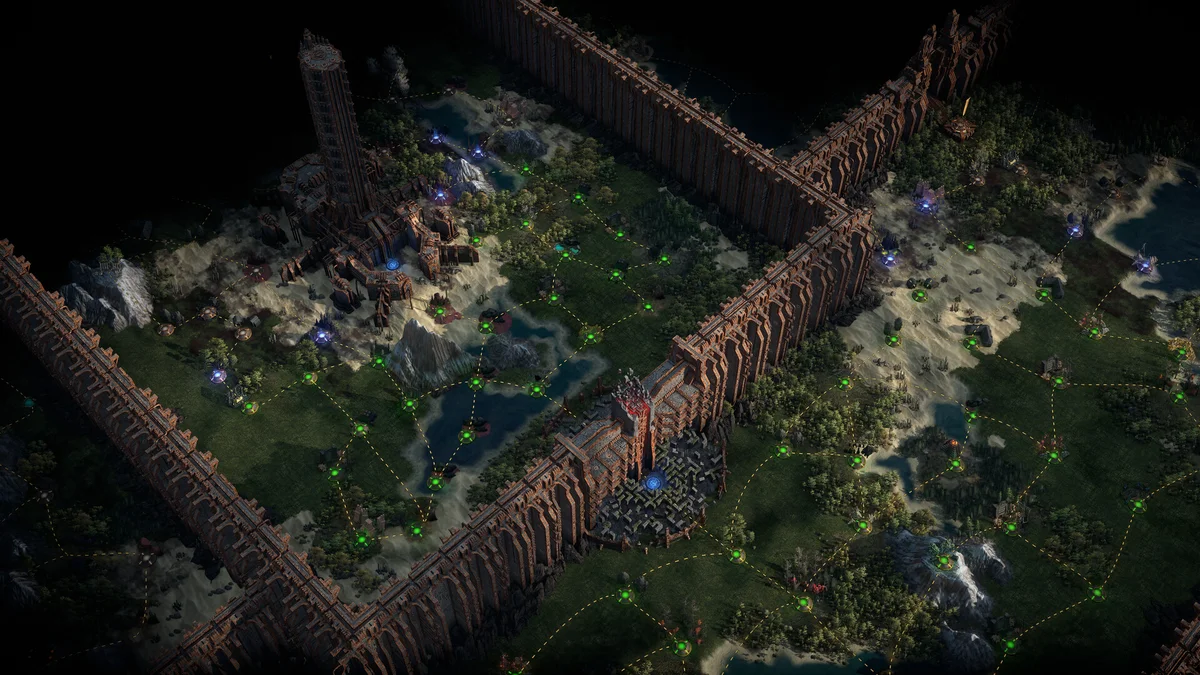
The campaign leans on the graphics card, yet the endgame leans on the processor. In the Atlas of Worlds, you run Waystone maps with dozens of enemies, projectiles, and effects on screen at once. The CPU must track every one of them. A system that only just meets the recommended spec falls short in those moments, since the CPU cannot keep up with the simulation. Group play makes it worse, since up to six players fill the map with more skills and more monsters. The game also stays online at all times, so the client must sync with the server while it renders the chaos. That is why endgame maps are CPU-heavy, and why a stronger CPU buys more smoothness than a stronger GPU at the same price.
The signs of a CPU limit are easy to spot. Frame rates drop when a pack explodes into loot and effects, yet they recover when the screen clears. The GPU sits below full load while the game still stutters, which means the card is waiting on the processor. Lowering the resolution does not fix it, since the simulation load stays the same. If that sounds familiar, the CPU is the part to upgrade, not the card. For the general test, see CPU bottlenecks in esports vs AAA games. For a handheld view, Steam Deck in 2026 covers how the game runs on the Deck.
Path of Exile 2 best CPU GPU picks by tier
Budget tier: if you already own a PC near the recommended spec, do not buy a new one for 1.0. An i5-10500 with an RTX 2060 clears the campaign and light maps, and 16GB of RAM is enough for solo play. Spend your money on an SSD first if you still run a hard drive, since the 100GB install loads far slower without one. The RTX 2060 is the floor here, not the target, and it shows its age in dense maps.
Balanced tier: this is our pick for most players. A Ryzen 5 7600X or Core i5-12400F gives you six fast cores. An RTX 4060 or RX 7600 gives you enough GPU headroom for 1440p maps. Pair them with 16GB of DDR5 and an NVMe SSD, and the game holds up in the Atlas. This tier costs far less than a flagship build, yet it covers the content that matters. See the ARC Raiders CPU bottlenecks guide for the same pairing logic.
High-end tier: buy this only if you run juiced maps, group play, or six-player parties every night. A Ryzen 7 9800X3D is the strongest gaming CPU for simulation-heavy games. An RTX 5070 or RX 9070 gives you room for 1440p at high settings. Add 32GB of RAM, since background apps and a browser full of trade tabs share the memory. This tier is overkill for the campaign, yet it is the only one that stays smooth when the screen fills completely. Before you buy, run the gpu bottleneck calculator to check the pair you already own.
Settings that save your frame rate in maps
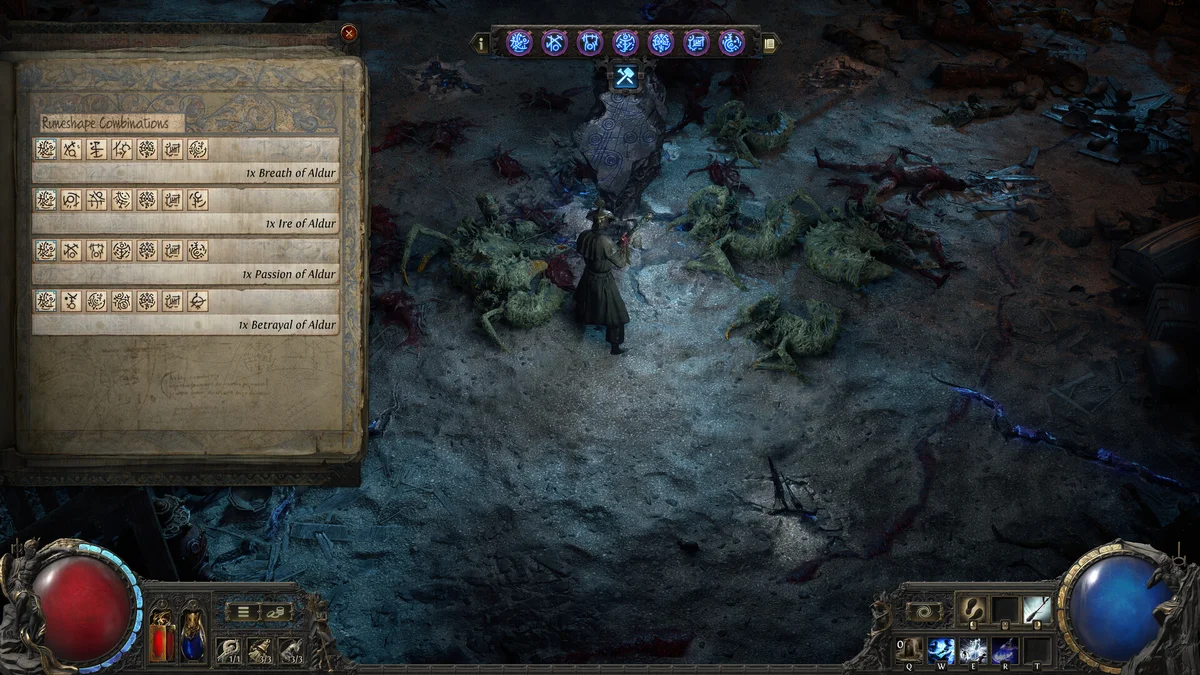
Settings help more than hardware in the endgame, so tune them before you buy parts. The game supports NVIDIA DLSS, AMD FSR 2, and Intel XeSS 1.3, and upscaling lifts the frame rate without touching the CPU load. Lower the effects density and the shadows first, since those two settings hit the CPU hardest in dense maps. Turn off screen shake and reduce the number of corpses shown, since both add work for no gain. Keep the game on an SSD, since area loads stall the game on a hard drive. And close the browser before a map, since trade tabs and streams eat the same cores the game needs.
Patch day is the worst day to judge speed. Give the game one clean session after a patch before you blame the hardware. If the stutter fades on the second run, it was the cache, not the CPU. If it stays in every dense map, the CPU is the limit, and the picks above are the fix.
The bottom line
Path of Exile 2 best CPU GPU picks for endgame maps start with a modern six-core CPU and an RTX 4060-class card. The Atlas punishes the processor more than the graphics card. The official recommended spec clears the campaign, yet it falls short in dense maps, so buy the CPU first and the GPU second. Launch is 11 Dec 2026, the game is free, and your PC has four weeks to get ready.
Frequently asked questions
Which processor holds frame rates up best in dense PoE 2 maps?
A modern six-core CPU like the Ryzen 5 7600X or Core i5-12400F is the best value pick for endgame maps. Endgame maps are CPU-heavy, since the game tracks dozens of enemies, projectiles, and effects at once. A Ryzen 7 9800X3D is the high-end pick for juiced maps and group play.
What card pairs best with a six-core CPU for PoE 2 maps?
The official recommended GPU is an RTX 2060, yet an RTX 4060-class card is the better pick for endgame maps. The recommended spec clears the campaign, while dense maps need more headroom. An RTX 5070 or RX 9070 is the high-end pick for 1440p at high settings.
Is 8GB of memory enough to play PoE 2 1.0 smoothly?
Yes, 8GB of RAM meets the official minimum spec, yet 16GB is the recommended amount and the safer pick. Endgame maps, background apps, and trade tabs all share the memory, so 8GB can stutter in dense content. Buy 16GB for solo play and 32GB for group play.
When does Path of Exile 2 1.0 launch?
Path of Exile 2 1.0 launches on 11 Dec 2026 in Pacific time, and it becomes free to play on PC, PlayStation 5, and Xbox Series X|S. Grinding Gear Games announced the date at ExileCon on 6 Nov 2026. The launch adds Acts 5 and 6, the Duelist and Shadow classes, and the Conquerors of Wraeclast league.
Is Path of Exile 2 CPU heavy or GPU heavy?
Path of Exile 2 is GPU heavy in the campaign and CPU heavy in the endgame. Campaign areas lean on the graphics card, while Atlas maps fill the screen with enemies, projectiles, and effects that the CPU must track. If frame rates drop only in dense maps, the CPU is the limit.
Can I play PoE 2 1.0 on a handheld like the Steam Deck?
Yes, Path of Exile 2 is Steam Deck Verified, and ProtonDB rates it Platinum. It runs well on the handheld at lower settings, yet dense endgame maps will push the Deck harder than the campaign. A desktop PC with a six-core CPU is the better pick for serious mapping.
How this guide was prepared
This guide uses Grinding Gear Games' Steam announcement (6 Nov 2026), the official Steam system requirements, gamingroute.com (8 Nov 2026), and pixelherald.com. It also uses megasystem.ad, and all sources were checked 16 Nov 2026. The 1.0 date, Acts 5 and 6, the Duelist and Shadow classes, and the Conquerors of Wraeclast league come from the ExileCon reveal.
Pick tiers are recommendations for endgame maps, not official specs and not measured benchmarks. No frame rates are claimed, since no 1.0 build has been tested.
Last updated: November 17, 2026