
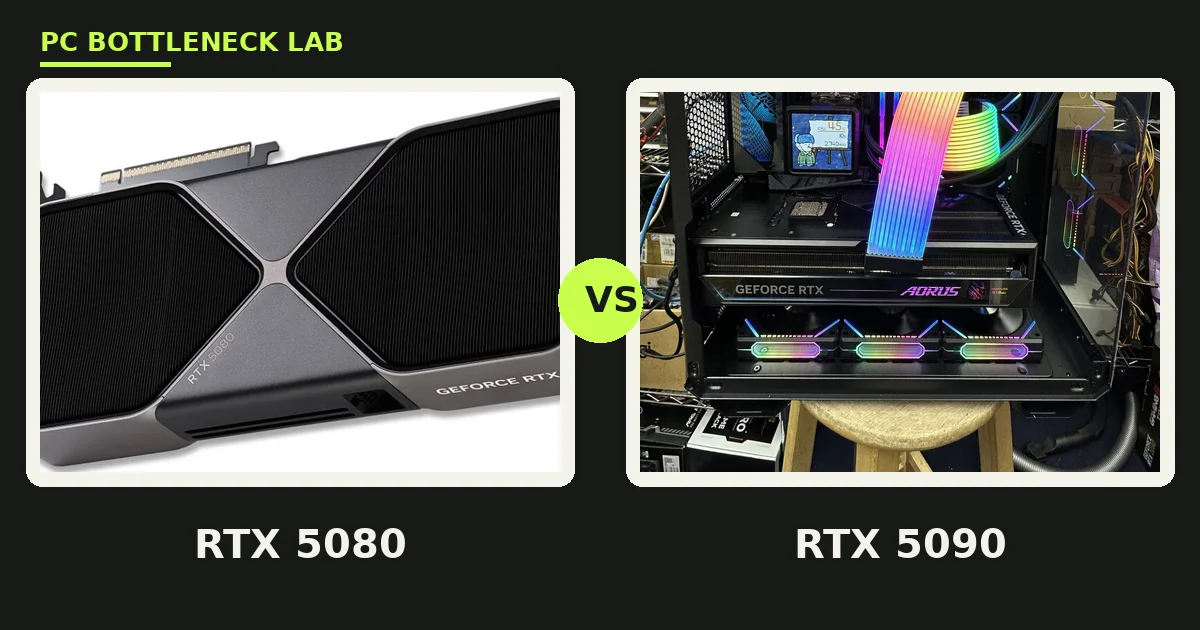
Key takeaways
- The RTX 5090 leads native 4K raster by about 50%: 105.8 fps against 70.1 fps in Tom's Hardware January 2025 averages.
- The 5090 has 32GB of VRAM against 16GB on the 5080, so it suits large textures and local AI work better.
- Both cards support DLSS 4 with Multi Frame Generation.
- At 4K the GPU sets the limit, so almost any modern six-core CPU feeds either card.
- The 5090 launched at $1,999 against $999 for the 5080, and street prices ran far above both in October 2026.
RTX 5080 vs RTX 5090 bottleneck: the short answer
For the RTX 5080 vs RTX 5090 bottleneck, the 5090 is faster in native games, and the 5080 is the better buy. Tom's Hardware measured the 5090 at 105.8 frames per second against 70.1 for the 5080 at 4K ultra. That is about 50% ahead, and TechPowerUp found the same gap in its own suite. The 5090 costs twice as much at launch, yet it is not twice as fast. Check your own pair with the free tool: bottleneck calculator.
| Question | RTX 5080 | RTX 5090 |
|---|---|---|
| Faster in native games | No, 70.1 fps at 4K | Yes, 105.8 fps at 4K |
| More VRAM | No, 16GB | Yes, 32GB |
| Lower power | Yes, 360 W | No, 575 W |
| Cheaper at launch | Yes, $999 | No, $1,999 |
| Best for | Most 4K builds | No-compromise 4K and AI work |
The table above is the short version, and the rest of this comparison explains each row. The 5090 wins on speed and memory, while the 5080 wins on price and power. The choice comes down to your budget and your monitor, not to a single benchmark. For the tier below this pair, see the RTX 4090 vs RTX 5080 bottleneck compared.
RTX 5080 vs RTX 5090 specs compared
A bottleneck is the part that finishes its work last, and it sets the frame rate. The 5090 is a Blackwell card from January 2025, built on the large GB202 die. The 5080 is a Blackwell card from the same launch, built on the smaller GB203 die. Both cards share the same architecture, yet the 5090 has more silicon. That gap is the whole story.
The 5090 has 21,760 CUDA cores against 10,752 on the 5080, which is about twice as many. Its 512-bit bus gives 1,792 GB/s of bandwidth, against 960 GB/s on the 256-bit bus of the 5080. The 5080 answers with the same DLSS 4 features, so it loses on speed, not on software. For the full 5090 details, see the GeForce RTX 5090 page.
| Spec | RTX 5090 | RTX 5080 |
|---|---|---|
| Architecture | Blackwell, GB202 | Blackwell, GB203 |
| CUDA cores | 21,760 | 10,752 |
| VRAM | 32GB GDDR7 | 16GB GDDR7 |
| Memory bus | 512-bit | 256-bit |
| Bandwidth | 1,792 GB/s | 960 GB/s |
| Boost clock | 2.41 GHz | 2.62 GHz |
| Power draw | 575 W | 360 W |
| Interface | PCIe 5.0 x16 | PCIe 5.0 x16 |
| Launch | January 2025, 1,999 dollars | January 2025, 999 dollars |
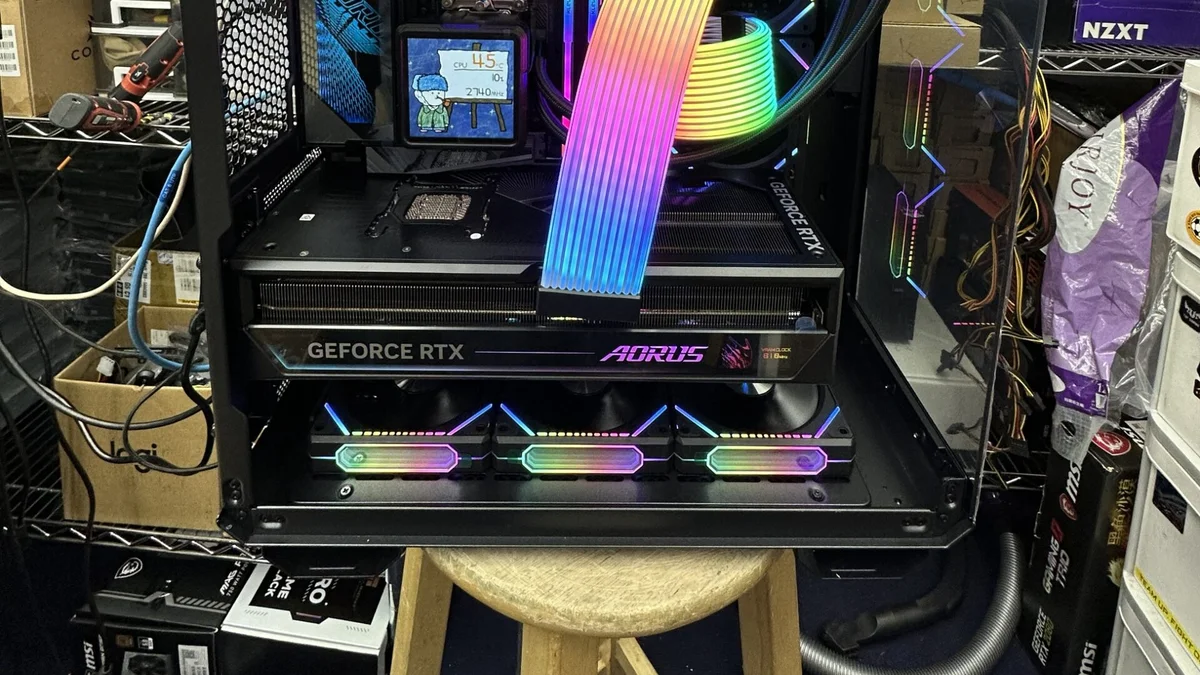
Native performance at 1080p, 1440p, and 4K
Native raster means no upscaling and no frame generation, so it shows the raw hardware. Tom's Hardware January 2025 averages put the 5090 at 105.8 frames per second and the 5080 at 70.1 at 4K ultra. That is a 50% lead for the 5090 in that suite. TechPowerUp found the 5090 about 52% faster at 4K. The honest range is an estimated 25% to 50% at 4K, since the gap grows in heavy games and shrinks in light ones.
At 1440p the gap is smaller, since both cards run fast and the CPU can limit them. In heavy ray-traced games the gap grows, since the 5090 has more cores and a wider bus. At 1080p the CPU matters most, since the cards finish frames fast. Neither card is a sensible 1080p buy, since cheaper cards already clear high refresh rates.
| Resolution | RTX 5080 | RTX 5090 | Who limits |
|---|---|---|---|
| 1080p | Very fast | Very fast | CPU |
| 1440p | Fast | Faster | Mixed, CPU and GPU share the load |
| 4K | 70.1 fps average | 105.8 fps average | GPU |
VRAM: 32GB against 16GB
VRAM is the memory on the graphics card, and it holds textures, models, and frame data. When it fills up, the driver spills data to system RAM, and that spill causes stutter. The 5090 has 32GB, so it holds the largest texture packs and local AI models without spilling. The 5080 has 16GB, which is enough for most games today.
This gap matters most outside gaming. Local AI work, large 3D scenes, and heavy texture packs use far more than 16GB. For gaming alone at 4K, 16GB is enough in most titles today, yet 32GB has more room for future games. The 5090 is the clear pick when memory is the real limit, while the 5080 is the pick when gaming is the whole job.
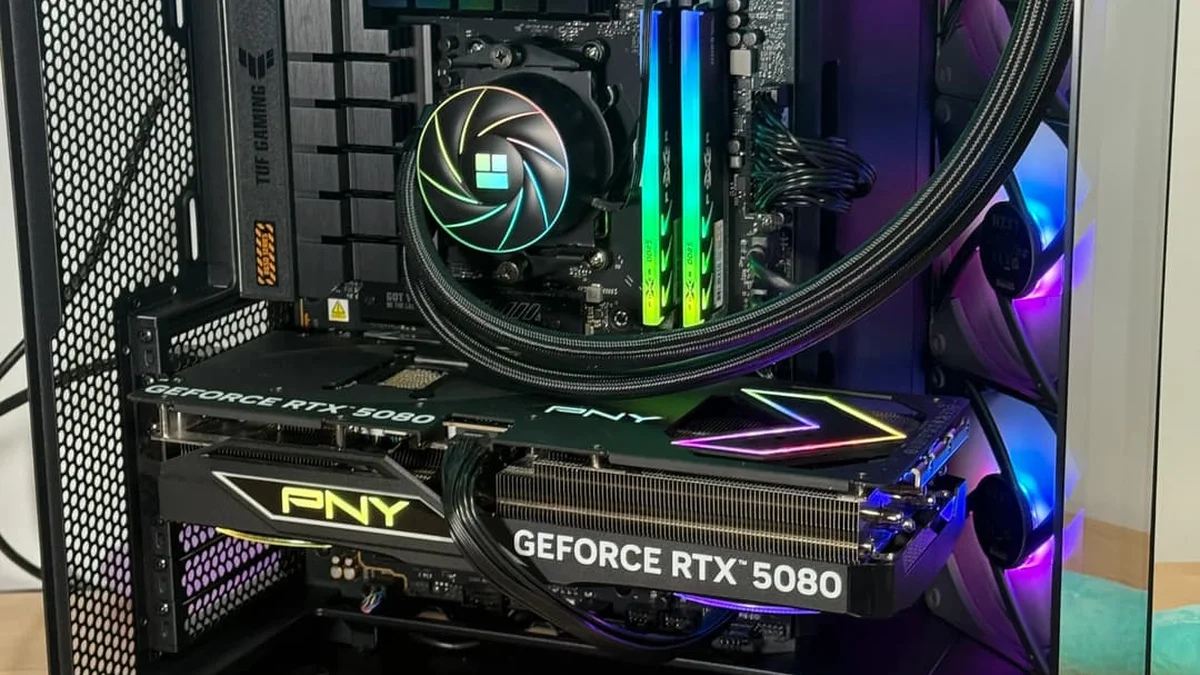
DLSS and frame generation: no feature gap
DLSS is NVIDIA upscaling, and it renders at a lower resolution, then rebuilds the image. Frame generation adds extra frames between real ones, which lifts the shown frame rate. Both cards support DLSS 4 with Multi Frame Generation, which adds up to three extra frames. That means the 5080 has no feature gap to close, unlike the older 4090. The 5090 still shows a higher frame rate, since it renders more real frames first.
With Multi Frame Generation on, both cards feel smoother in supported games. That shown rate is not the same as rendered speed, since generated frames add latency. For competitive play, native frames matter more than generated ones, while story games feel better with the smoother shown rate. Buy the card for its native speed, and treat frame generation as a bonus.
RTX 5080 vs RTX 5090 bottleneck: CPU needs
A CPU bottleneck is when the processor finishes last, and it caps the frame rate. At 4K the GPU sets the limit for both cards, so almost any modern six-core CPU feeds either one. TechSpot paired the Ryzen 7 9800X3D with a six-core Ryzen 5 7600X on an RTX 5080, and the two posted identical numbers at 4K ultra. The same holds for the 5090, since the GPU works even harder there.
At 1440p ultra the 9800X3D kept about a 9% lead in that TechSpot run, and the gap grew in CPU-heavy games. At 1080p the CPU matters most, since the cards finish frames fast. A Ryzen 7 9800X3D is the top pick for high-refresh play, while a six-core chip is enough for 4K. For the best CPU for the smaller card, see the best CPU for RTX 5070 Ti and 5080.
Price, power, and availability
The 5090 launched at 1,999 dollars, and the 5080 launched at 999 dollars. That is a 1,000 dollar gap at launch, for about 50% more speed at 4K. Street prices ran far above launch in October 2026, though. A price survey from 9 October 2026 found the cheapest 5090 near $6,886 and the cheapest 5080 near $1,600. For the full price picture, see the GPU prices in November 2026 for RTX 50 cards.
Power favours the 5080 too. It draws 360 W against 575 W for the 5090, so it needs a smaller power supply and runs cooler. A good 850 W unit suits the 5080, while the 5090 wants a 1,000 W unit as a rule of thumb. The 5090 also needs a big case, since partner models run long. Check your case and your power supply before you buy either card.
Which flagship should you buy?
Buy the RTX 5080 for the best 4K card for the money. It is fast enough for most games, and it costs far less. Buy the RTX 5090 only when native speed and 32GB of VRAM beat price and power. That means local AI work or a no-compromise 4K rig. Check the street price first, since a high price erases the 5090 advantage. For the full 5080 guide, see the RTX 5080 bottleneck guide.
One more point matters: availability. The 5090 has sold far above its launch price since launch, while the 5080 has stayed closer to its own. Buy the 5080 now, and wait for the 5090 only when money is no object.
The bottom line on the RTX 5080 vs RTX 5090 bottleneck
The RTX 5080 vs RTX 5090 bottleneck ends with native speed on the 5090 side, by about 50% at 4K. The RTX 5080 is the smarter buy for most builders. Speed and memory favour the 5090, while price and power favour the 5080. Check your pair first on the gpu bottleneck calculator before you spend on new parts.
Frequently asked questions
Is the RTX 5090 really 50% faster than the RTX 5080?
Yes, at 4K in native raster games. Tom's Hardware January 2025 averages put the 5090 at 105.8 frames per second against 70.1 for the 5080, which is about 50% ahead. TechPowerUp found the 5090 about 52% faster at 4K. The gap shrinks in lighter games, so the range is an estimated 25% to 50% at 4K. At 1080p the CPU limits both cards, so the gap vanishes.
Is the RTX 5080 better value than the RTX 5090?
Yes, for gaming. The 5080 launched at $999 against $1,999 for the 5090, yet it delivers about two-thirds of the 4K speed. That makes its cost per frame far lower at launch prices. Street prices widened the gap further by October 2026, with the cheapest 5090 near $6,886 against $1,600 for the 5080. Buy the 5090 only when 32GB of VRAM or top speed is the job.
Will 16GB of VRAM hold the RTX 5080 back at 4K in 2026?
No, not for most games at 1440p and 4K today. The 5080 handles current titles well with 16GB of GDDR7 memory. The 5090 has 32GB, which suits larger texture packs, local AI work, and heavy 3D scenes. For gaming alone, 16GB is enough now, yet 32GB has more room for future games. Buy the 5090 when memory is the real limit.
Which CPU feeds an RTX 5090 best at 4K?
A modern six-core CPU feeds the 5090 at 4K, since the GPU sets the limit there. TechSpot found a six-core Ryzen 5 7600X equal to the Ryzen 7 9800X3D at 4K ultra on an RTX 5080. At 1440p ultra the 9800X3D kept about a 9% lead, and at 1080p the CPU matters most. Buy the 9800X3D for high-refresh play, and keep a six-core chip for 4K.
How much PSU headroom should an RTX 5090 rig have?
A good 1,000 W unit suits the RTX 5090 as a rule of thumb, since the card draws 575 W on its own. The RTX 5080 needs only a good 850 W unit, since it draws 360 W. Check the 12V-2x6 connector too, because both cards use the newer plug. Buy a quality unit from a known brand.
Should I buy an RTX 5090 for AI work instead of gaming?
Yes, when local AI is the job. The 5090's 32GB of VRAM fits larger models without splitting them, and its 1,792 GB/s of bandwidth feeds them fast. The 5080 has only 16GB, so big models spill to system RAM and slow down. For gaming alone, the 5080 is the smarter buy, since it costs far less. Buy the 5090 when memory, not frames, is the limit.
How this guide was prepared
This comparison uses the published specs of NVIDIA. It also uses the Tom's Hardware January 2025 review averages, the TechPowerUp RTX 5080 review, and the TechSpot CPU and GPU scaling run. Street prices come from a price survey dated 9 October 2026. The performance gaps are the named sources' figures, labelled as estimates, not our own tests. The prices shown are the makers' launch figures unless a date is given.
Last updated: November 17, 2026