
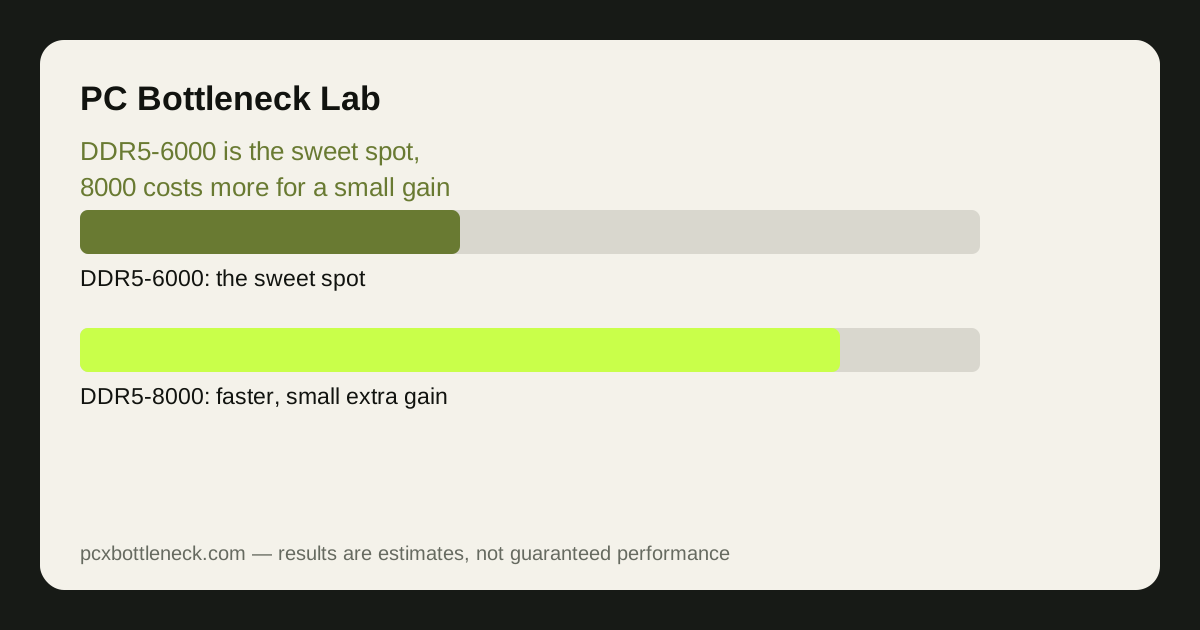
Why DDR5-6000 is the sweet spot on AM5
On AMD's AM5 platform, the memory controller talks to the Infinity Fabric — the link between the CPU cores, the memory controller and the rest of the chip — at a ratio that matters more than the raw RAM speed. Up to about 6400 MT/s, the controller and the fabric run at a 1:1 ratio, so data moves between them with no extra delay. DDR5-6000 with CL30 timings sits comfortably inside that 1:1 window, with low latency and full bandwidth, which is why it is the widely recommended sweet spot.
Above about 6400 MT/s, the controller drops to a 2:1 ratio: the fabric runs at half the memory speed. The RAM itself is faster, but every transfer now crosses a slower link, and the extra latency eats into the benefit of the higher speed. DDR5-8000 is therefore not simply "a third faster than DDR5-6000" — it is faster RAM behind a slower bridge, and the net gain is far smaller than the speed number suggests.
Intel platforms behave differently, with more headroom before the equivalent trade-off appears, so very fast RAM can help more there. But the general lesson holds on both platforms: RAM speed is only useful if the rest of the memory path can use it. For the background on how RAM speed interacts with the CPU, see DDR4 vs DDR5 RAM speed and whether RAM can cause a bottleneck.
What DDR5-8000 actually buys, in reported tests
| Scenario | Reported gain from DDR5-8000 vs DDR5-6000 | Why |
|---|---|---|
| 1440p / 4K, GPU-bound AAA | Roughly 1–5% | The GPU is the limit, so faster RAM waits on the card |
| 1080p, CPU-bound esports | Up to roughly 10–12% in cherry-picked titles | The CPU is the limit, so memory speed shows up |
| 1080p, average across many games | A small single-digit gain | Most games are not purely CPU-bound |
| Simulation / strategy, heavy scenes | A modest gain in heavy scenes | More data moving through memory per frame |
| Productivity (rendering, compiling) | Varies widely by workload | Some workloads love bandwidth, others do not |
Competitor-reported tests agree on the shape of the answer: DDR5-8000 CL38 buys roughly 1 to 5% at 1440p and 4K, and up to roughly 10 to 12% in cherry-picked CPU-bound 1080p titles. Those are reported ranges from other reviewers' tests, not measurements from PC Bottleneck Lab, and the top of the range comes from games chosen precisely because they respond to memory speed.
The pattern is the familiar one: memory speed matters when the CPU is the limit, and barely matters when the GPU is the limit. At 1440p and 4K with high settings, the GPU takes so long per frame that the CPU has plenty of time to fetch data, so faster RAM sits idle. At 1080p in a CPU-bound game, the CPU is the pace-setter, and faster memory lets it work a little quicker — but only a little, because the fabric ratio and the latency of high-speed kits cap the benefit.
Price, stability and the value question
The value question is where extreme DDR5-8000 kits usually lose. Kits beyond DDR5-6000 cost substantially more than DDR5-6000 CL30, and a RAM shortage in 2026 has pushed kit prices up across the board, so the price gap is larger than it was. Paying a large premium for a reported 1 to 5% gain at the resolutions most people play at is a poor return, especially when the same money buys a meaningful graphics card or CPU upgrade.
Capacity is still the more important RAM decision for most players. Two sticks totalling 32GB in dual-channel mode matters far more than the difference between 6000 and 8000 MT/s, and a single stick — however fast — loses the dual-channel benefit entirely. If your budget is limited, spend it on capacity and dual-channel first, and on speed only after those are settled. See how much RAM you need for gaming in 2026 before choosing a kit.
Who should buy DDR5-8000 — and who should not
DDR5-8000 makes sense for a small group: competitive players chasing every frame at 1080p on a strong CPU, overclockers who enjoy tuning memory, and Intel-platform builders whose memory controller has the headroom to use the speed. For those buyers, the small gain is the point, and the price is acceptable.
For everyone else — the large majority of builders — DDR5-6000 CL30 is the right buy. It is cheaper, more stable, and within a few percent of the faster kit in the games and resolutions most people actually play. The money saved is better spent on the graphics card, the CPU, or simply kept in your pocket.
- Buy DDR5-6000 CL30 first: the AM5 sweet spot, stable with EXPO enabled.
- Check capacity and channels: 32GB in two matched sticks beats a faster single stick.
- Only consider 8000 MT/s for CPU-bound 1080p play: that is where the gain actually appears.
- Test stability: run a memory stress test after enabling EXPO, and step down if errors appear.
Before spending on RAM, run your CPU and GPU through the PC bottleneck calculator — if the result is GPU-limited at your resolution, faster RAM will not move it, and the money belongs on the graphics card.
Limitation: the gain figures here are competitor-reported ranges, not PC Bottleneck Lab measurements. They depend on the game, the CPU, the motherboard and the kit's timings, and the top of the range comes from cherry-picked titles. Treat them as a guide to the size of the effect, not as a promise for your PC.
Frequently asked questions
Is DDR5-8000 faster than DDR5-6000 for gaming?
Slightly, in CPU-bound games at 1080p — competitor-reported tests put the gain at roughly 1 to 5% at 1440p and 4K, and up to about 10 to 12% in cherry-picked CPU-bound 1080p titles.
Why is DDR5-6000 the sweet spot on AM5?
Because the memory controller holds a 1:1 ratio with the Infinity Fabric up to about 6400 MT/s.
Do DDR5-8000 timings matter?
Yes. Fast kits usually run looser timings, such as CL38 versus CL30, so each memory access takes more cycles. That latency offsets part of the raw speed gain, which is one reason the real-world benefit of DDR5-8000 is smaller than the speed number suggests.
Is DDR5-8000 worth it in 2026?
For most players, no. The reported gain is small at the resolutions most people play at, the price premium is large — and larger during the 2026 RAM shortage — and stability can need manual tuning. DDR5-6000 CL30 is the better buy for the large majority of builders.
Should I buy faster RAM or more RAM?
More RAM first, in dual-channel mode. Two sticks totalling 32GB matters far more than the difference between 6000 and 8000 MT/s, and a single fast stick loses the dual-channel benefit. Settle capacity and channels, then consider speed.