
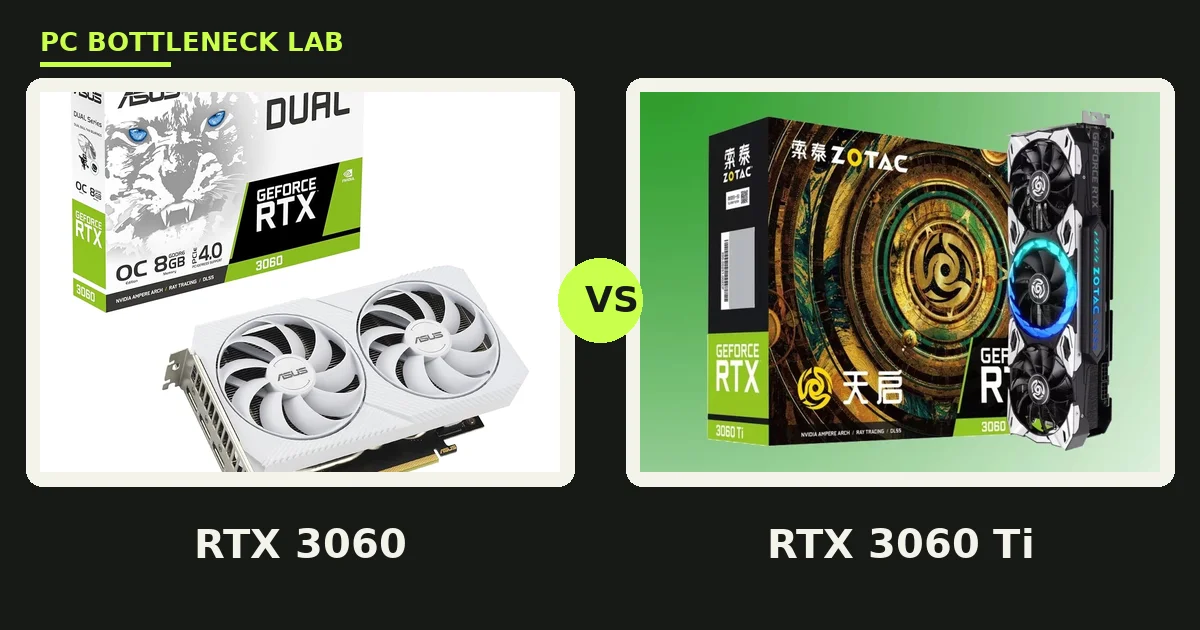
Key takeaways
- The RTX 3060 Ti is about 25-30% faster in games, with 36% more CUDA cores and 24% more bandwidth.
- The RTX 3060 has 12GB of VRAM against 8GB on the Ti, so it suits heavy textures and local AI work better.
- Both cards are Ampere from 2020-2021, and both sell only on the used market in 2026.
- At 1080p the Ti wins outright, while at 1440p the 3060's extra memory can save its 1% lows.
- Used prices in October 2026 sat near $300 for the 3060 and near $250 for the Ti, so the slower card costs more.
RTX 3060 vs RTX 3060 Ti bottleneck: the short answer
For the RTX 3060 vs RTX 3060 Ti bottleneck, the Ti is faster in games, and the 3060 is better for memory-heavy work. The Ti has 4,864 CUDA cores against 3,584 on the 3060, which is 36% more. That gap shows as roughly 25-30% more frames in most titles. The 3060 answers with 12GB of VRAM against 8GB on the Ti. Check your own pair with the free tool: pc bottleneck calculator.
| Question | RTX 3060 | RTX 3060 Ti |
|---|---|---|
| Faster in games | No | Yes, about 25-30% |
| More VRAM | Yes, 12GB | No, 8GB |
| More bandwidth | No, 360 GB/s | Yes, 448 GB/s |
| Lower power | Yes, 170 W | No, 200 W |
| Cheaper used | No, near $300 | Yes, near $250 |
| Best for | Textures and AI work | 1080p and 1440p gaming |
The table above is the short version, and the rest of this comparison explains each row. The Ti wins on speed, while the 3060 wins on memory. The used prices flip the normal logic, since the slower card costs more. The choice comes down to your games and your work, not to a single benchmark. For the tier above this pair, see the RTX 3070 CPU bottleneck guide.
RTX 3060 vs RTX 3060 Ti specs compared
A bottleneck is the part that finishes its work last, and it sets the frame rate. The 3060 is an Ampere card from February 2021, built on the smaller GA106 die. The 3060 Ti is an Ampere card from December 2020, built on the larger GA104 die. The Ti is really a cut-down RTX 3070, not a beefed-up 3060, and that fact explains the whole comparison.
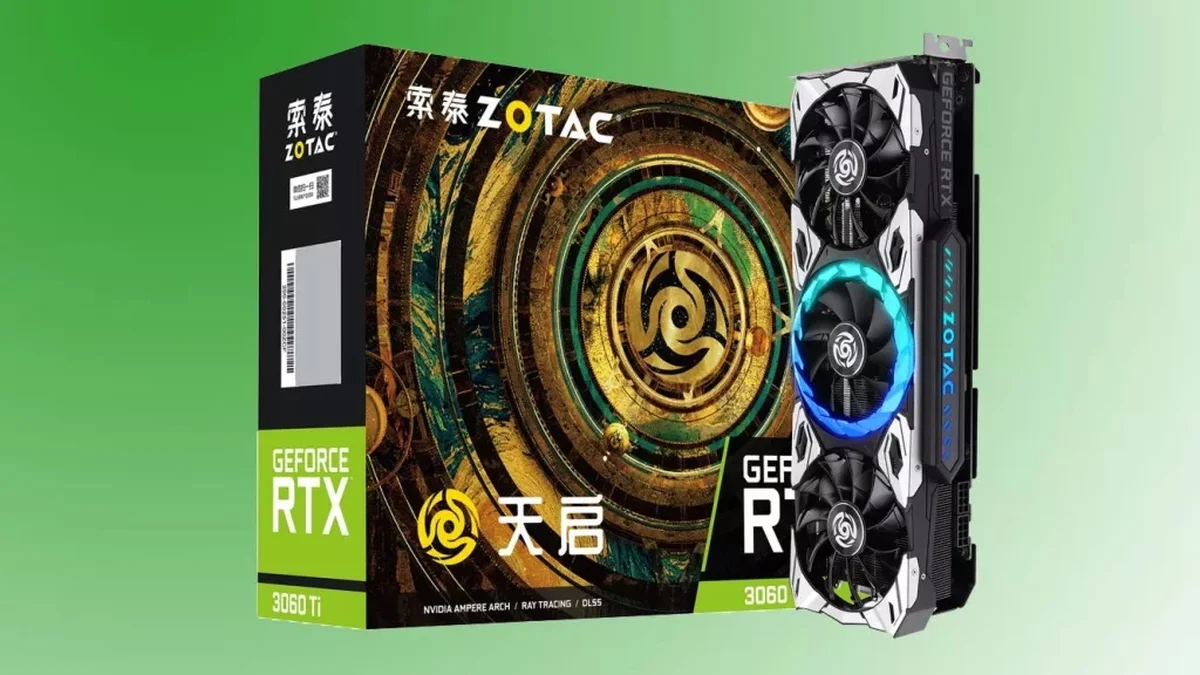
The Ti has 4,864 CUDA cores against 3,584 on the 3060, which is 36% more. Its 256-bit bus gives 448 GB/s of bandwidth, against 360 GB/s on the 192-bit bus of the 3060. The 3060 answers with 12GB of VRAM against 8GB on the Ti. For the full Ti details, see the GeForce RTX 3060 Ti page.
| Spec | RTX 3060 | RTX 3060 Ti |
|---|---|---|
| Architecture | Ampere, GA106 | Ampere, GA104 |
| CUDA cores | 3,584 | 4,864 |
| RT cores | 28 | 38 |
| VRAM | 12GB GDDR6 | 8GB GDDR6 |
| Memory bus | 192-bit | 256-bit |
| Bandwidth | 360 GB/s | 448 GB/s |
| Boost clock | 1.78 GHz | 1.67 GHz |
| Power draw | 170 W | 200 W |
| Launch | February 2021, 329 dollars | December 2020, 399 dollars |
Gaming performance at 1080p and 1440p
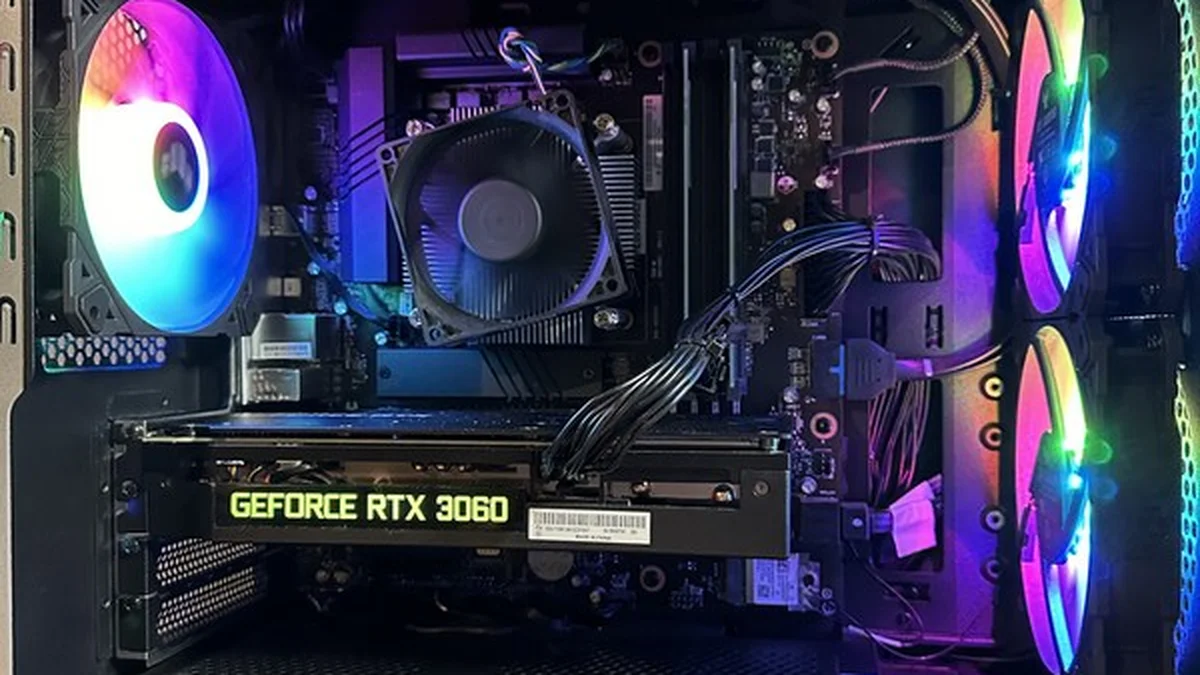
The Ti leads by roughly 25-30% across most modern titles, and that gap follows the spec sheet. It has 36% more cores fed by 24% more bandwidth, so the resources scale together. At 1080p the Ti is the clear winner, since 8GB is rarely the limit there. In Cyberpunk 2077 with ray tracing at 1080p, the Ti posts 37 frames per second against 28 for the 3060. That is 32% ahead, and it shows the gap in a heavy game.
At 1440p the story gets more complex, since 8GB can start to bind. The Ti still posts the higher average in most games, yet its 1% lows fall off when memory fills. The 3060 can post better 1% lows in texture-heavy titles at 1440p, even though it loses on averages. Averages alone mislead you here, since frame times matter more, and both cards can reach 1440p with DLSS on.
| Test | RTX 3060 | RTX 3060 Ti |
|---|---|---|
| Cyberpunk 2077, ray tracing, 1080p | 28 fps | 37 fps |
| Most modern titles | Slower by 25-30% | Faster by 25-30% |
| 1440p texture-heavy 1% lows | Steadier | Can dip when 8GB fills |
| Esports at 1080p | Fast enough | 25-30% faster |
VRAM: 12GB against 8GB
VRAM is the memory on the graphics card, and it holds textures, models, and frame data. When it fills up, the driver spills data to system RAM, and that spill causes stutter. The 3060 has 12GB, so it holds ultra texture packs without spilling. The Ti has 8GB, which was fine in 2020 yet binds in some 2026 titles.
This gap matters most outside gaming. Local AI work runs 14B models on the 3060, while 8GB caps you near 7-8B models. Video editing with large timelines also favours the extra memory. For gaming alone at 1080p, 8GB is still enough in most titles. The 3060 is the clear pick when memory is the real limit.
RTX 3060 vs RTX 3060 Ti bottleneck: CPU needs
A CPU bottleneck is when the processor finishes last, and it caps the frame rate. Both cards are slow enough that almost any modern CPU feeds them at 1080p. A Ryzen 5 5600 or Core i5-12400F is enough for either card, and faster chips add little, since the GPU sets the limit at 1440p. For the best CPU for the cheaper card, see the best CPU for RTX 3060.
One warning matters more than the CPU: the RTX 3060 8GB. It is not a 12GB card with less memory, since it runs a 128-bit bus at 240 GB/s. That is a third less bandwidth than the 12GB model, so it plays worse in every way. Check the box and the listing before you buy, and avoid the 8GB model. For the older card's own guide, see the RTX 3060 CPU bottleneck guide.
Used prices and what to pay in 2026
Both cards sell only used in 2026, since NVIDIA stopped making them years ago. Used prices in October 2026 sat near $300 for the 3060 and near $250 for the Ti, based on eBay sold listings. That means the slower card costs about $50 more, which flips the normal value logic. The premium pays for 12GB of VRAM, not for speed. For the used-market traps to avoid, see the used GPUs in 2026 guide.
Check the card before you pay, since used cards carry no warranty. Ask for a photo of the card running a game, and check the fan noise in the video. Avoid cards from mining farms when the seller cannot show test results. A clean card with a fair price beats a cheap card with a hidden fault. Pay with a method that protects you, and test the card on day one.
Which card should you buy?
Buy the RTX 3060 Ti when you play esports and older titles at 1080p, since it is 25-30% faster there. Buy the RTX 3060 when you play modern AAA games at 1440p, since its 12GB keeps frame times steady. Buy the 3060 for local AI work too, since 8GB cannot fit the models you want. The Ti is the gaming pick, and the 3060 is the memory pick.
One more point matters: the future. Games keep asking for more VRAM, so the 3060 ages better than the Ti in texture-heavy titles. The Ti ages better in raw speed, yet speed means little when memory runs out. If you play both kinds of games, buy the 12GB card, since a slower card is a compromise and a stuttering card is a defect.
The bottom line on the RTX 3060 vs RTX 3060 Ti bottleneck
The RTX 3060 vs RTX 3060 Ti bottleneck ends with speed on the Ti side, by about 25-30% in games. The RTX 3060 is the smarter buy for texture-heavy games and local AI work. Speed favours the Ti, while memory and used value favour the 3060. Check your pair first on the cpu gpu bottleneck calculator before you spend on a used card.
Frequently asked questions
Is the RTX 3060 Ti really 25-30% faster than the RTX 3060?
Yes, in most modern titles. The Ti has 36% more CUDA cores and 24% more bandwidth, so the gap follows the spec sheet. In Cyberpunk 2077 with ray tracing at 1080p, the Ti posts 37 frames per second against 28 for the 3060. That is 32% ahead in a heavy game. The gap shrinks only when the Ti runs out of its 8GB of VRAM.
Is 12GB of VRAM better than 8GB for gaming in 2026?
Yes, for modern AAA games at 1440p with ultra textures. The 3060's 12GB holds big texture packs without spilling to system RAM, so its 1% lows stay steadier. At 1080p the difference is small, since 8GB rarely binds there. For local AI work the gap is bigger, since 12GB fits 14B models while 8GB caps you near 7-8B. Buy memory for the games you play.
On the used market, RTX 3060 or RTX 3060 Ti?
Buy the Ti for esports and older titles at 1080p, since it is 25-30% faster there. Buy the 3060 for modern AAA games at 1440p and for local AI work, since its 12GB keeps frame times steady. Used prices in October 2026 sat near $300 for the 3060 and near $250 for the Ti. Check the card running a game first, since used cards carry no warranty.
Can the RTX 3060 run modern games at 1440p?
Yes, with settings tuned. The 3060 runs most modern titles at 1440p high settings, and DLSS lifts it further. Its 12GB of VRAM helps here, since ultra textures fit without spilling. The Ti is faster on averages at 1440p, yet its 8GB can dip the 1% lows in texture-heavy scenes. Both cards are 1080p-first cards that can stretch to 1440p.
Which budget CPU suits an RTX 3060 Ti?
A Ryzen 5 5600 or Core i5-12400F is enough for either card at 1080p and 1440p. Both cards are slow enough that almost any modern CPU feeds them, and faster chips add little. At 1440p the GPU sets the limit, so the CPU matters even less. Spend the money on the card and the monitor first, not on a faster CPU.
Is the RTX 3060 8GB version worth buying?
No, avoid it. The 8GB model is not a 12GB card with less memory, since it runs a 128-bit bus at 240 GB/s. That is a third less bandwidth than the 12GB model, so it plays worse in every way. The whole point of the 3060 is its 12GB of memory, and the 8GB version gives that up. Check the box and the listing, and buy the 12GB model only.
How this guide was prepared
This comparison uses the published specs of NVIDIA. It also uses the willitbottleneck comparison page and the InsiderLLM local AI test from October 2026 for frame rates and model sizes. Used prices come from eBay sold listings dated October 2026. The performance gaps are the named sources' figures, labelled as estimates, not our own tests. The prices shown are the makers' launch figures unless a date is given.
Last updated: November 17, 2026