
What the RTX 5070 actually draws
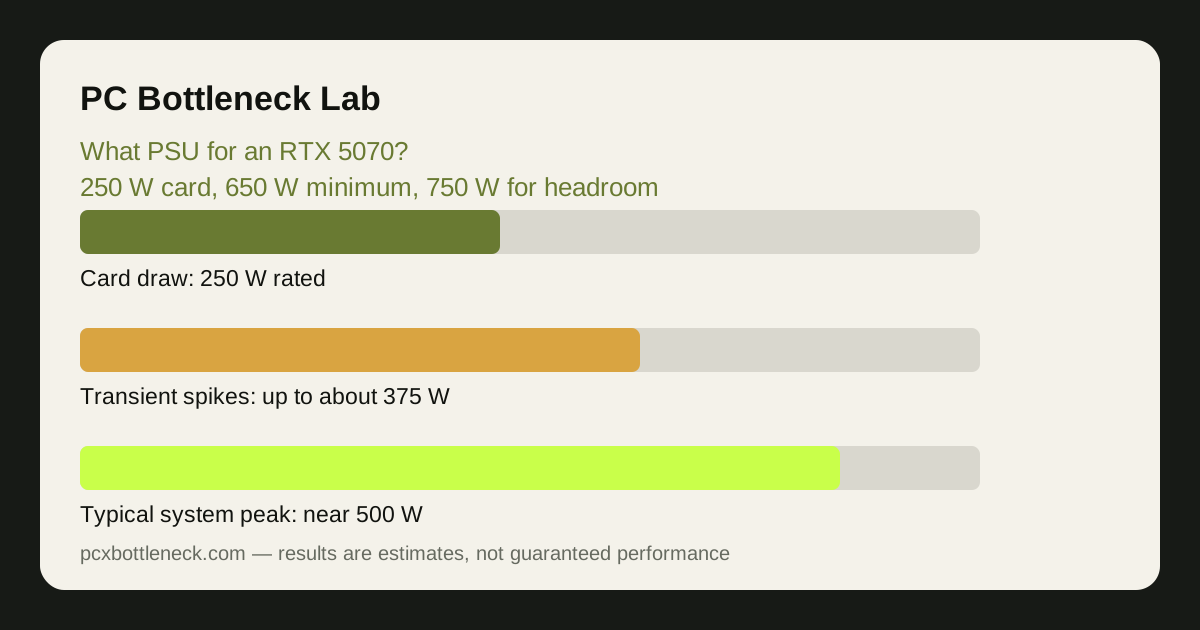
The RTX 5070 has a published total graphics power of 250 W — its rated draw under load, including memory and cooling. It is not the whole system's draw: CPU, motherboard, memory, storage and fans all add their share, so size the supply for the whole PC.
There is also a transient spike: when a card's load changes suddenly — a scene cut, a new area loading — it can briefly draw far more than its rated power. For the RTX 5070, spikes can reach roughly 375 W for a fraction of a second. A good supply absorbs spikes like that; a poor one may shut the PC down even though its label looks big enough.
That is why the unit's quality matters as much as the number on the box: a 650 W supply handles this card comfortably, while a 750 W unit with weak components may not — wattage is the headline, but build quality keeps the PC running.
650 W or 750 W: which PSU for an RTX 5070
NVIDIA's published minimum for an RTX 5070 system is 650 W, assuming a typical mainstream-CPU build. A system pairing the card with a Ryzen 7 9800X3D peaks near 500 W under full gaming load, leaving comfortable headroom on a good 650 W unit. That is the core of the answer: 650 W is enough, provided the unit is good.
| Your build | Recommended PSU | Why | Notes |
|---|---|---|---|
| RTX 5070 + mainstream CPU, ATX 3.1 | 650 W, good quality | Covers the ~500 W peak | The standard pick |
| RTX 5070 + high-end CPU | 750 W | Extra parts and a hungrier CPU | Comfortable at full load |
| RTX 5070 + older ATX 2.x unit | 750 W | Older designs handle spikes poorly | Prefer a native 12V-2x6 cable |
| RTX 5070 + planned GPU upgrade | 750 W or more | Headroom avoids a second PSU later | Check the future card's guidance |
| RTX 5070 + overclocking | 750 W | Overclocking raises draw on both | Watch temperatures too |
The ATX version matters here. ATX 3.1 units are designed for these transient spikes and usually come with a native 12V-2x6 connector — the single plug that powers the 5070. Older ATX 2.x units can still work, but they rely on an adapter and handle spikes less gracefully, so 750 W is the safer pick for them.
The 12V-2x6 connector and the adapter question
The RTX 5070 uses one 12V-2x6 power connector, the newer version of the 12VHPWR plug. The difference is small but important: the revised connector has shorter sense pins, so the card can detect whether the plug is fully seated before drawing full power — the same idea as the older plug, with a fix for the seating problems that made headlines with earlier cards.
If your supply has a native 12V-2x6 cable, use it — one cable, one plug, no adapter. If not, the card ships with an adapter taking two or three 8-pin PCIe plugs from the PSU. With an adapter, plug it in firmly until it clicks, leave no gap at the socket, and avoid bending the cable sharply at the connector. A loose or strained plug is the one avoidable risk in this installation.
Do not use splitters or third-party cables that did not come with the PSU or the card: the connector carries a lot of current through a small plug, and the wrong cable is a genuine fire risk.
How to check your current PSU before buying
Before ordering a new unit, check what you already have: the label lists wattage, ATX version and 80 Plus rating, and the model number lets you look up professional reviews. A unit five or more years old, or one bundled with a cheap case, deserves a closer look even if the wattage number seems right.
- Read the label: confirm the wattage, the ATX version, and whether it has a native 12V-2x6 cable.
- Check the 12 V rail: the label shows the 12 V rail's wattage — the number that powers the CPU and GPU, which should be close to the unit's total rating.
- Look up a review: a professional review tells you whether the unit delivers its rated power and handles spikes, which the box never will.
- Count the cables: make sure you have enough PCIe plugs for the adapter — no splitters.
If you are sizing the whole system rather than one card, our PSU wattage calculation guide adds up every part by hand. Once the card is installed, run the pair through the PC bottleneck calculator to check the balance — a well-fed 5070 deserves a CPU that can keep up, as our 9800X3D + 5070 guide shows.
Limitation: the wattage figures here are guidance from published ratings and typical system peaks, not a measurement of your PC. Actual draw depends on your CPU, overclock, drives and fans — add up your own parts, or measure at the wall, before settling on a unit.
Frequently asked questions
Is a 650 W PSU enough for an RTX 5070?
Yes, if it is a good-quality unit — NVIDIA's published minimum for a system with this card is 650 W, and a typical 9800X3D + 5070 system peaks near 500 W. The key is quality: a well-built 650 W ATX 3.1 unit beats a cheap 750 W one.
Can I use a 550 W PSU with an RTX 5070?
It is not recommended. The card draws 250 W and can spike to roughly 375 W, leaving too little margin for the CPU and the rest of the system on a 550 W unit. 650 W is the published minimum — going below it risks shutdowns under load.
Does the RTX 5070 need an ATX 3.0 or 3.1 power supply?
Not strictly — an older ATX 2.x unit can work with the included adapter — but ATX 3.1 is better, designed for transient spikes and usually including a native 12V-2x6 cable, so there is no adapter in the chain.
What happens if my PSU is too weak for an RTX 5070?
The most common symptom is the PC shutting down or restarting under gaming load, when transient spikes push the PSU past what it can deliver. In a bad case a weak unit can also damage components — which is why a quality PSU is cheap insurance.
Do I need a new PSU if I upgrade from an RTX 4060 to a 5070?
Often yes: the 4060 draws far less power, so a 550 W unit that was fine for it may be below the 650 W minimum for the 5070. Check the label and ATX version first — a good 650 W ATX 3.1 unit may already be enough.