
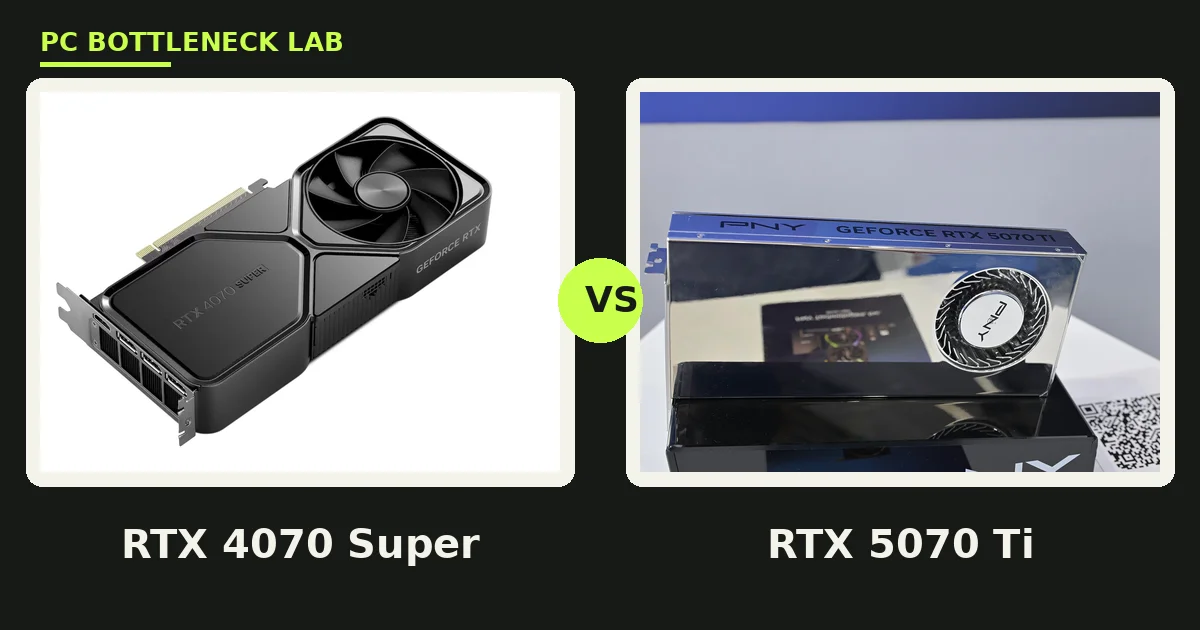
Key takeaways
- The RTX 5070 Ti is faster at every resolution, and its lead grows as resolution rises.
- 16GB versus 12GB of VRAM is the real divider, and it matters most at 4K with high textures.
- At 1080p both cards are fast enough that the CPU decides the result more often.
- DLSS 4 Multi Frame Generation runs only on the RTX 5070 Ti, while the RTX 4070 Super keeps DLSS 3 frame generation.
- The RTX 4070 Super draws 80W less, so it runs cooler and asks less of your power supply.
RTX 4070 Super vs RTX 5070 Ti bottleneck: the short answer
A bottleneck is the part that holds the rest of the system back, and in this pair the answer changes with resolution. At 1080p the CPU often sets the pace for both cards, since neither card works hard at that resolution. At 1440p and 4K the GPU takes over, and the RTX 5070 Ti pulls ahead on cores, bandwidth, and VRAM. The RTX 4070 Super vs RTX 5070 Ti bottleneck question is really a resolution question, not a card question. Check your own pair first with the free bottleneck calculator before you spend on either card.
| Spec | RTX 4070 Super | RTX 5070 Ti |
|---|---|---|
| Architecture | Ada Lovelace | Blackwell |
| CUDA cores | 7,168 | 8,960 |
| VRAM | 12GB GDDR6X | 16GB GDDR7 |
| Memory bus | 192-bit | 256-bit |
| Memory bandwidth | 504 GB/s | 896 GB/s |
| Boost clock | 2.48 GHz | 2.45 GHz |
| Power draw (TDP) | 220W | 300W |
| Launch price (MSRP) | $599, January 2024 | $749, February 2025 |
| Frame generation | DLSS 3 | DLSS 4 Multi Frame Generation |
Where the 16GB VRAM gap actually matters
VRAM is the memory on the graphics card that holds textures, models, and frame data while a game runs. The RTX 5070 Ti carries 16GB of GDDR7, while the RTX 4070 Super carries 12GB of GDDR6X. That 4GB gap is the biggest practical difference between the two cards, and it grows in value as games get heavier. At 1080p and 1440p with high settings, 12GB still covers most games in 2026. At 4K with ultra textures or ray tracing, usage climbs past 12GB in the heaviest titles, and the card starts swapping data to system RAM. That swap shows up as stutter, not as a lower average frame rate. For the full VRAM story, see this: VRAM bottleneck: 8GB vs 12GB vs 16GB.
How much faster is the 5070 Ti in games
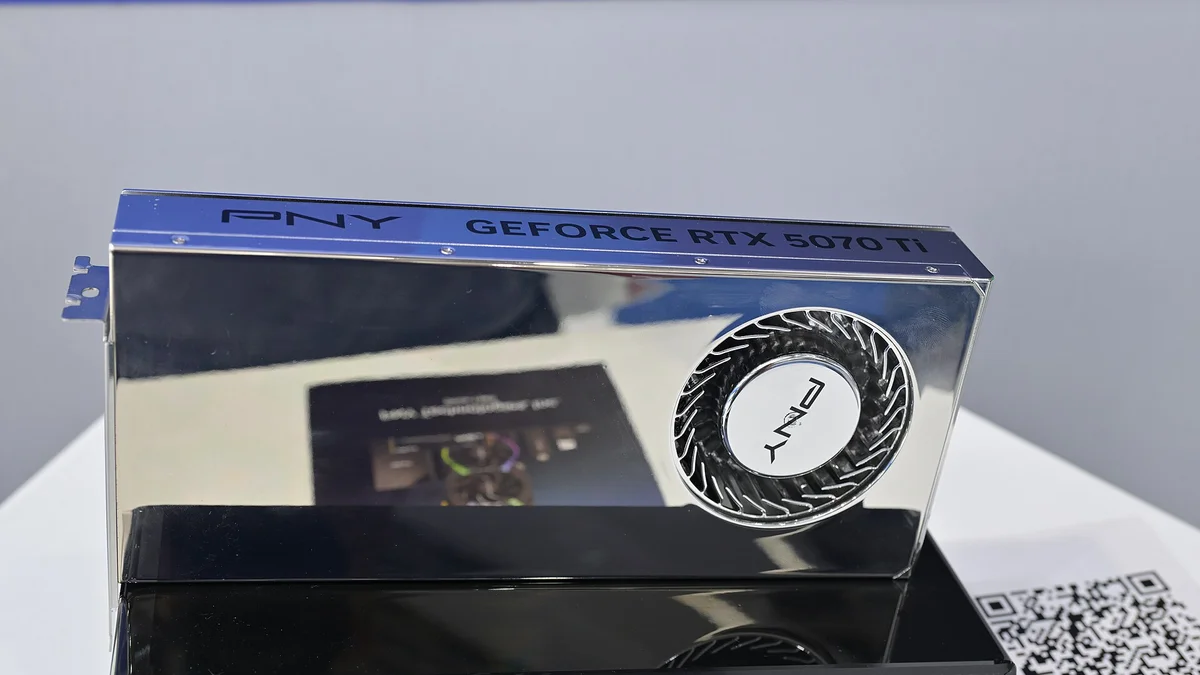
The RTX 5070 Ti wins in games, but published tests disagree on the size of the win. That spread is normal, since each test uses a different game mix, CPU, and driver version. The honest picture is a range, not a single number. DropReference measured the RTX 5070 Ti about 13 percent faster at 1440p across its reference games. CheckFPS, using estimated averages from popular games, put the lead near 32 percent at 1080p, 35 percent at 1440p, and 44 percent at 4K. NanoReview scored the two cards 76 and 64 in gaming, and measured up to 39 percent better in the synthetic Steel Nomad Lite test. Technical City, whose aggregate leans on synthetic tests, put the gap near 8 percent. Treat the 1440p lead as roughly 13 to 35 percent in real games, and treat single-number claims with care. The closest same-tier comparison on our site is this: RTX 4070 vs RTX 5070 bottleneck compared.
| Source | What it measured | RTX 5070 Ti lead |
|---|---|---|
| DropReference | 1440p average across reference games | About 13% |
| CheckFPS (estimated) | 1080p, 1440p and 4K in popular games | About 32%, 35% and 44% |
| NanoReview | Gaming score, 76 vs 64 | About 19% on score |
| NanoReview | Steel Nomad Lite, synthetic | Up to 39% |
| Technical City | Aggregate, synthetic-heavy | About 8% |
Bottleneck by resolution: 1080p, 1440p and 4K
Resolution decides which part limits your frame rate, and that rule shapes this whole comparison. At 1080p the GPU finishes frames fast, so the CPU becomes the limit in many games. A mid-range CPU can hold back either card here, and the RTX 5070 Ti shows its smallest lead. At 1440p the load shifts to the GPU, and the RTX 5070 Ti opens a clear gap. At 4K the GPU does nearly all the work, and the gap grows again, with VRAM joining in. The RTX 4070 Super vs RTX 5070 Ti bottleneck balance therefore flips as you raise the resolution. For the CPU side of this story, see this: RTX 5070 Ti CPU bottleneck: which CPU you need.
| Resolution | What limits the frame rate | VRAM pressure | Pick |
|---|---|---|---|
| 1080p | CPU more often | Low | 4070 Super is enough; 5070 Ti for 240Hz monitors |
| 1440p | GPU mostly | Medium | 5070 Ti pulls clearly ahead |
| 1440p high-refresh | GPU, CPU at very high FPS | Medium | 5070 Ti with a strong CPU |
| 4K | GPU | High | 5070 Ti, with 16GB headroom |
DLSS 4 and ray tracing: the feature split
DLSS is NVIDIA upscaling tech that renders at a lower resolution and rebuilds the image, and frame generation adds AI-made frames between real ones. DLSS 4 Multi Frame Generation inserts up to three AI frames per real frame, and it runs only on RTX 50-series cards. The RTX 4070 Super keeps DLSS 3 frame generation, which adds one frame per real frame, plus the newer DLSS 4 transformer upscaling model. In ray tracing the RTX 5070 Ti also leads, since it has more cores and faster memory to push through heavy lighting. But frame generation is not free speed. It raises the displayed frame rate while the real input latency stays tied to the base frame rate. So a weak base frame rate still feels sluggish, even with a high displayed number. For the frame generation story in full, see this: DLSS 4 Multi Frame Generation CPU bottleneck.
Power, heat and PSU
The RTX 5070 Ti draws 300W against the RTX 4070 Super at 220W, so the newer card asks 80W more from your power supply. That gap also means more heat in the case, and a louder fan curve under load. Both cards use the 16-pin power connector, so check your supply has the right cable or adapter before you buy. A good 750W power supply covers the RTX 5070 Ti in most builds, while the RTX 4070 Super is comfortable on 650W. These are rule-of-thumb figures, not a guarantee for every build. A power-hungry CPU or many drives can push the real draw higher, so add headroom if your build is loaded.
Which card should you buy
Buy the RTX 5070 Ti if you play at 1440p high-refresh or 4K. It also suits you if you want extra VRAM for the next few years of games. Buy the RTX 4070 Super if you play at 1080p or 1440p at 60 to 144Hz. It also wins if lower power draw and a lower price matter more to you. If you already own the RTX 4070 Super, the step up is hard to justify, since the gain is real but not dramatic. Spend that money on a better CPU or monitor instead, unless you are moving to 4K. If you are buying new and the price gap is small, the RTX 5070 Ti is the better long-term pick. For CPU pairings for the faster card, see this: best CPU for RTX 5070 Ti and 5080.
The bottom line on the RTX 4070 Super vs RTX 5070 Ti bottleneck
The RTX 4070 Super vs RTX 5070 Ti bottleneck story is simple once you fix the resolution. At 1080p the CPU matters more than the card. At 1440p the RTX 5070 Ti pulls ahead, and at 4K its 16GB of VRAM seals the win. The RTX 4070 Super stays a strong 1440p card with lower power draw. The RTX 5070 Ti is the better buy for high-refresh 1440p and 4K. Run your exact parts through the GPU bottleneck calculator before you buy. Your CPU and monitor decide how much of the gap you will see.
Frequently asked questions
Does the RTX 5070 Ti beat the RTX 4070 Super at 1440p by a wide margin?
Yes, but the margin depends on the test. DropReference measured about a 13 percent lead at 1440p across its reference games, while CheckFPS estimated about 35 percent from popular games. Most 1440p suites land between those two numbers, so expect a clear but not dramatic lead. The gap grows at 4K, where the extra VRAM and bandwidth help more.
Is 12GB of VRAM enough for 4K gaming on the RTX 4070 Super?
It is enough for many 4K games, but not for the heaviest ones at ultra settings. Some 2025 and 2026 titles push past 12GB with ultra textures and ray tracing, and then the card swaps data to system RAM. That swap causes stutter even when average frame rates look fine. Lowering texture quality one step usually fixes it.
Should I upgrade from an RTX 4070 Super to an RTX 5070 Ti?
Most owners should not, since the gain is real but not dramatic at 1440p. The step up makes sense only if you are moving to 4K or to a high-refresh 1440p monitor, and if the price gap is small. Otherwise the money works harder on a faster CPU, a better monitor, or a larger SSD.
Does the RTX 4070 Super support DLSS 4 Multi Frame Generation?
No. Multi Frame Generation is exclusive to RTX 50-series cards, so the RTX 4070 Super cannot use it. The card does support DLSS 3 frame generation, which adds one AI frame per real frame. It also gets the newer DLSS 4 transformer upscaling model. That model improves image quality on both generations of cards.
Which CPU keeps up with the RTX 5070 Ti at 1080p?
A modern 8-core CPU such as the Ryzen 7 7800X3D or 9800X3D keeps up well at 1080p, since fast cache matters most there. A strong 6-core like the Ryzen 5 9600X also works, though it leaves less headroom at very high frame rates. Avoid older 6-core chips here, since the CPU becomes the limit before the GPU does.
How much power does the RTX 5070 Ti need compared with the RTX 4070 Super?
The RTX 5070 Ti draws 300W against 220W for the RTX 4070 Super, a gap of 80W. A good 750W power supply covers the RTX 5070 Ti in most builds, while the RTX 4070 Super is comfortable on 650W. Both cards use the 16-pin connector, so check your supply has the right cable or adapter before you buy.
How this guide was prepared
This guide compares the RTX 4070 Super and RTX 5070 Ti using NanoReview, DropReference, CheckFPS, Technical City, and NVIDIA specification pages. Specs, launch prices, and power figures come from the manufacturers and those comparison pages. The performance gaps are reported as the ranges those sources published. No frame rates were measured by us, and no street price is claimed.
Last updated: November 12, 2026