
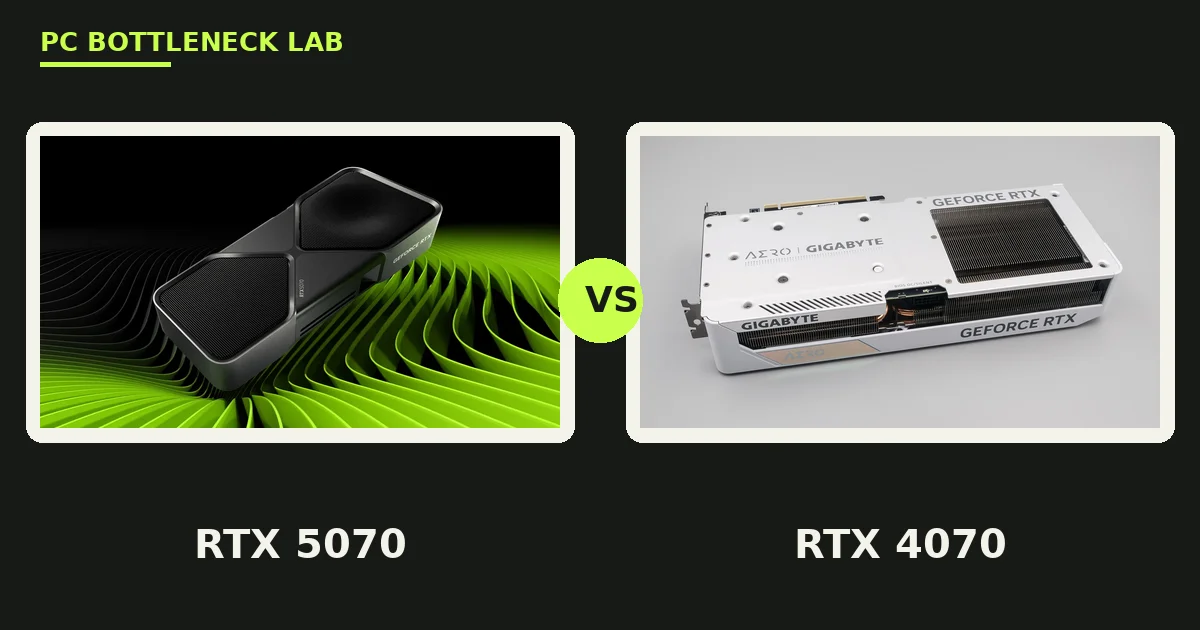
Key takeaways
- The 5070 is about 20% faster at 1440p, per Tech4Gamers (19.3%) and Deltias Gaming (20.7%).
- Both cards have 12GB of VRAM. The 5070's speed comes from faster memory and more cores, not capacity.
- The 5070 launched at $549, $50 below the 4070's $599 launch price.
- The 4070 is out of production since November 2024. Its street price rose to $839 in October 2026.
- Verdict: buying new, get the 5070. Owning a 4070, do not upgrade for 20%.
RTX 4070 vs RTX 5070 specs: what changed
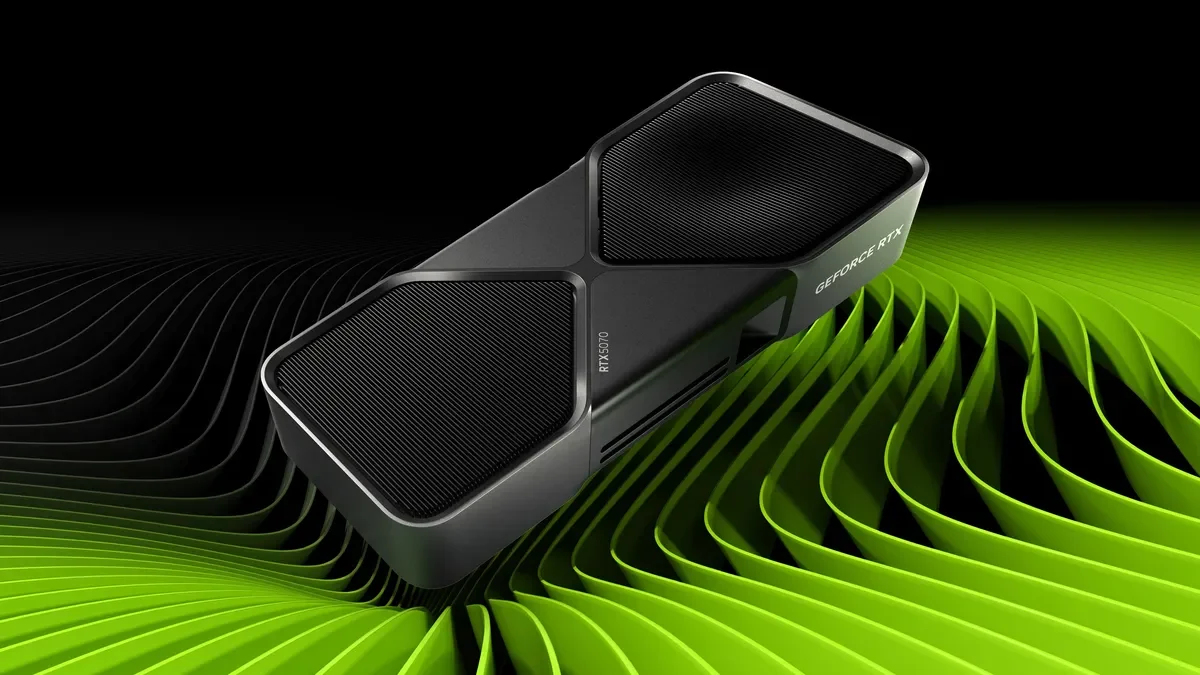
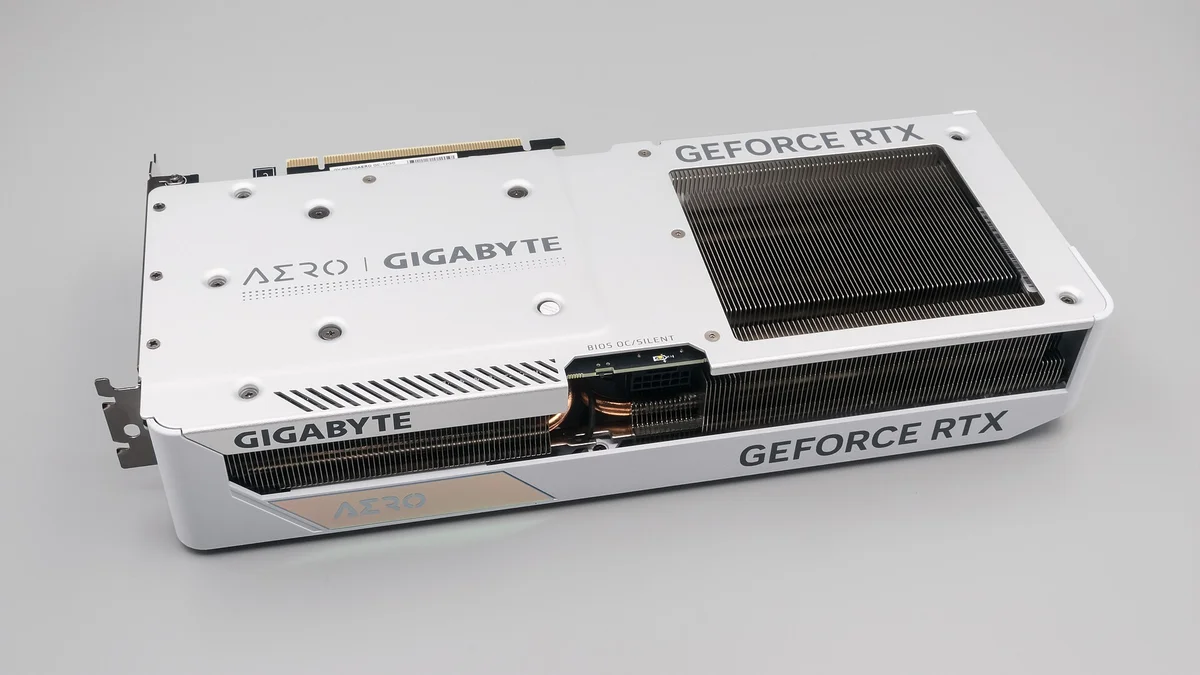
The 5070 is one generation newer, yet the spec sheet is a small step, not a leap. The CUDA core count rises from 5,888 to 6,144, a gain of about 4%. The big change is the memory. GDDR7 runs at 28 Gbps against GDDR6X at 21 Gbps, so bandwidth rises from 504 to 672 GB/s, a gain of one third. The 5070 also brings 4th-gen ray tracing cores, 5th-gen tensor cores, and DLSS 4 with Multi Frame Generation. The price is the surprise. The 5070 launched at $549, $50 below the 4070's launch price of $599. The table below is the reference spec, checked in November 2026.
| Spec | RTX 4070 | RTX 5070 |
|---|---|---|
| Architecture | Ada Lovelace (AD104) | Blackwell (GB205) |
| CUDA cores | 5,888 | 6,144 |
| VRAM | 12GB GDDR6X | 12GB GDDR7 |
| Memory bandwidth | 504 GB/s | 672 GB/s |
| Boost clock | 2.48 GHz | 2.51 GHz |
| TGP | 200W | 250W |
| DLSS | DLSS 3 + Frame Generation | DLSS 4 + Multi Frame Generation |
| Launch date | 13 April 2023 | 5 March 2025 |
| Launch price | $599 | $549 |
The gaming gap by resolution
The gaming gap is real, and it grows with resolution. At 1080p the gap stays under 10%, since the CPU becomes the limit before the card does. At 1440p the 5070 opens up a lead of about 20%. Tech4Gamers tested 8 games at 1440p and found the 5070 was 19.3% faster than the 4070. Deltias Gaming tested 10 games at 1440p and found 20.7% more FPS. At 4K the lead is 10% to 15%, per launch reviews from TechPowerUp and Tom's Hardware. Ray tracing widens the gap further. In native ray-traced gaming the 5070 is typically 20% to 28% faster. The biggest gains show up in Cyberpunk 2077, Alan Wake 2, and other Unreal Engine 5 titles. DLSS 4 adds Multi Frame Generation, which creates up to three extra frames per rendered frame, against one extra frame with DLSS 3 Frame Generation. The slowest frames, called 1% lows, show a CPU limit first. For the frame-time story in full, see this: stuttering and frame time: 1% lows explained.
| Resolution | 5070 lead over 4070 | Source |
|---|---|---|
| 1080p | Under 10% | TechPowerUp, Tom's Hardware |
| 1440p | About 20% (19.3% / 20.7%) | Tech4Gamers, Deltias Gaming |
| 4K | 10% to 15% | TechPowerUp, Tom's Hardware |
| Ray tracing (native) | 20% to 28% | Launch reviews |
Bottleneck: which CPU does each card need?
At 1080p the 5070 needs a stronger CPU to show its lead. A Ryzen 5 7600X or better lets the 5070 stretch, while a weak CPU ties the two cards together. At 1440p both cards are GPU-bound with a mid-range CPU, so a 7600X or a Core i5-12400F feeds either card. At 4K any modern 6-core CPU feeds either card, and the CPU choice stops mattering. Check your own pair before you buy with the free tool: bottleneck calculator. For the full check method, see this: how to check for a CPU bottleneck. The power draw differs too. The 5070 draws 250W against 200W for the 4070, so it needs a 750W PSU while the 4070 runs on 650W. The VRAM ceiling is the same for both. Both cards have 12GB, so VRAM-heavy games hit the same wall on either card. For the VRAM story in full, see this: VRAM bottleneck: 8GB vs 12GB vs 16GB.
DLSS 4 vs DLSS 3: the frame generation gap
DLSS 4 is the 5070's biggest feature lead. Multi Frame Generation creates up to three extra frames per rendered frame, while DLSS 3 Frame Generation creates one. In a game running at 60 FPS native, DLSS 4 can show 240 FPS on screen, while DLSS 3 shows 120 FPS. These are displayed frames, not rendered frames, and input lag grows with each generated frame. The 4070 is not left out entirely. It gets DLSS 4 Super Resolution and the new transformer model, since NVIDIA backported those to all RTX cards. Multi Frame Generation stays exclusive to Blackwell, so the 4070 never gets it. For competitive shooters, frame generation adds lag and most players turn it off. For single-player games on a high-refresh monitor, it is the 5070's clearest win.
Price and value: which card should you buy?
Buying new, get the 5070. It is faster, newer, and actually on shelves, and it launched cheaper than the 4070 did. The 4070 has largely disappeared from store shelves, and its price rose after production ended. NVIDIA stopped shipments to board partners in November 2024, and the card was not restocked after January 2025. A price tracker showed $839 on 6 October 2026, a 12-month range of $719 to $930. The full price story is here: GPU prices rising November 2026: buy before Black Friday. Owning a 4070, do not upgrade for 20%. A 5070 Ti or an RTX 4080 Super is a 45% to 55% jump. That is a better use of the budget than a lateral 20% move within the same VRAM tier, per one comparison site. A used 4070 only makes sense at a steep discount, since the 5070 is the better new card at a lower launch price.
The bottom line on RTX 4070 vs RTX 5070
RTX 4070 vs RTX 5070 comes down to one question. Are you buying new, or do you already own the 4070? Buying new, the 5070 wins: about 20% faster at 1440p, stronger ray tracing, DLSS 4, and a lower launch price. Owning a 4070, the upgrade is not worth it, since 20% is a small jump for the money and the VRAM ceiling stays the same. Check your pair first on the CPU bottleneck calculator before you spend. For the tier below these cards, see this: best CPU for RTX 5060 and 5060 Ti.
Frequently asked questions
Is the RTX 5070 faster than the RTX 4070?
Yes. The 5070 is about 20% faster at 1440p, per Tech4Gamers (19.3% over 8 games) and Deltias Gaming (20.7% over 10 games). At 1080p the gap is under 10%, since the CPU becomes the limit. At 4K the lead is 10% to 15%. In native ray tracing the 5070 is 20% to 28% faster, with the biggest gains in Cyberpunk 2077 and Alan Wake 2.
Is the RTX 5070 worth upgrading from a 4070?
No, for most owners. A 20% gain is a small jump for the money, and both cards have the same 12GB of VRAM. A 5070 Ti or an RTX 4080 Super is a 45% to 55% jump. That is a better use of the budget than a lateral move within the same VRAM tier. Upgrade from a 4070 only when you need DLSS 4 Multi Frame Generation.
Do the RTX 4070 and 5070 have the same VRAM?
Yes, both have 12GB. The difference is the type and speed. The 4070 uses 12GB of GDDR6X at 504 GB/s, while the 5070 uses 12GB of GDDR7 at 672 GB/s, a gain of one third. The capacity ceiling is the same, so VRAM-heavy games hit the same wall on either card. The speed gain helps at 1440p and 4K.
What CPU feeds an RTX 5070 properly?
A Ryzen 5 7600X or better lets the 5070 stretch at 1080p, while a weak CPU ties it to the 4070's speed. At 1440p both cards are GPU-bound with a mid-range CPU, so a 7600X or a Core i5-12400F feeds either card. At 4K any modern 6-core CPU feeds either card, and the CPU choice stops mattering.
What size power supply does the 5070 need?
A 750W PSU is the safe pick for the 5070, since it draws 250W against 200W for the 4070. The 4070 runs on a 650W PSU. Buy a quality unit from a known brand, and check that it has the right connector for your card. A good PSU lasts through two or three GPU upgrades, so do not cut corners here.
Is the RTX 4070 still worth buying in 2026?
Only used, and only at a steep discount. The 4070 is out of production since November 2024, and new stock has largely disappeared. Its street price rose to $839 in October 2026, far above its $599 launch price. At that price the 5070 is the better new card, since it is faster, newer, and launched at $549.
How this guide was prepared
This guide uses NVIDIA's specifications for both cards, and the published tests of Tech4Gamers, Deltias Gaming, TechPowerUp, Tom's Hardware, and TechRadar. The performance figures are attributed to those tests, not our own. The price figures are launch prices and reported street prices.
Last updated: November 11, 2026