
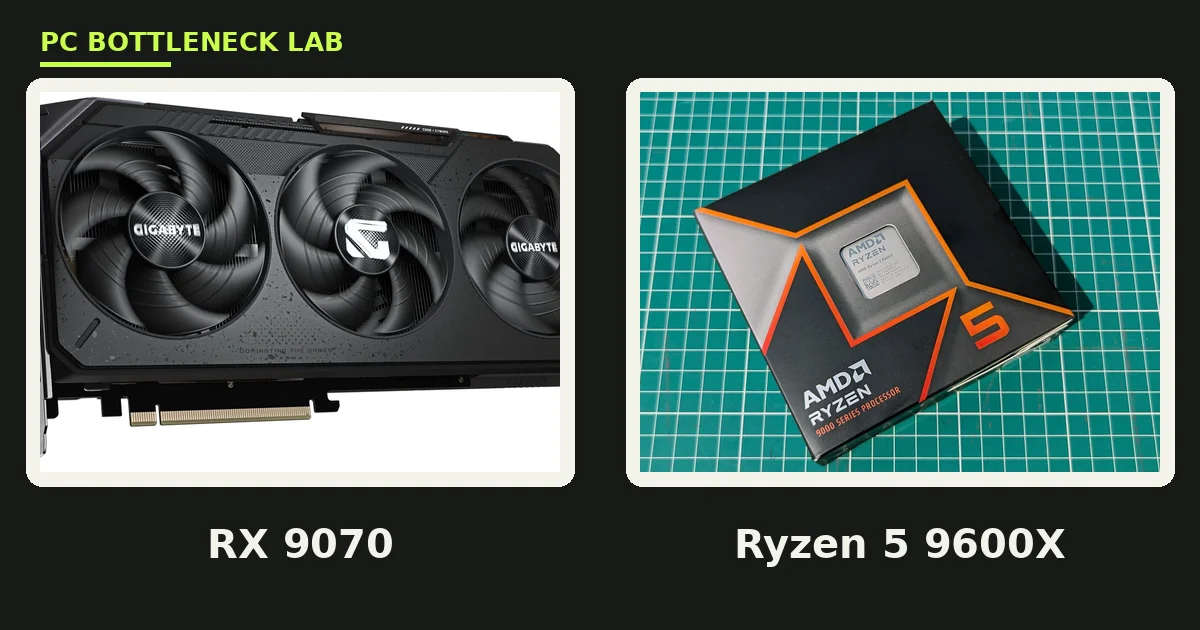
Key takeaways
- A Ryzen 5 9600X or Core i5-14600K feeds the RX 9070 fully at 1080p and 1440p in most games.
- At 1440p, the card is the limit in most AAA games, so a mid-range CPU is enough.
- 16 GB of VRAM gives the RX 9070 more headroom than 12 GB cards at 1440p and 4K.
- Smart Access Memory helps on AMD platforms, but it cannot rescue a weak CPU.
- FSR 4 upscaling raises FPS, yet it cannot fix a CPU that is too slow.
RX 9070 bottleneck: the short answer
A CPU bottleneck happens when your processor cannot prepare frames fast enough for your graphics card. The GPU then waits between frames, and your FPS drops below what the card can deliver. With the RX 9070, this happens most at 1080p, where frames are cheap for the GPU and the CPU sets the pace. At 1440p it happens far less, and at 4K almost never with a modern CPU. For a quick check of your own pair, run the free pc bottleneck calculator before you buy anything.
What the RX 9070 actually is
The RX 9070 launched on March 6, 2025, at $549. It uses the Navi 48 chip with 56 compute units and 3,584 stream processors. Memory is 16 GB of GDDR6 on a 256-bit bus, with 640 GB/s of bandwidth. Total board power is 220 W. The card sits just below the RX 9070 XT, which has 64 compute units and draws 304 W. Both cards share 16 GB of memory, so the non-XT is a slower chip with the same memory for $50 less at launch. That makes the CPU question simple: the same mid-range CPU feeds both cards in most games.
| Spec | RX 9070 | RX 9070 XT |
|---|---|---|
| Compute units | 56 | 64 |
| Stream processors | 3,584 | 4,096 |
| VRAM | 16 GB GDDR6 | 16 GB GDDR6 |
| Memory bus | 256-bit | 256-bit |
| Bandwidth | 640 GB/s | 640 GB/s |
| Board power | 220 W | 304 W |
| Launch price | $549, March 2025 | $599, March 2025 |
RDNA 4 is the architecture behind both cards. It brings much stronger ray tracing than RDNA 3, plus FSR 4 upscaling with machine-learning image reconstruction. Ray tracing still costs the GPU a lot of performance, so it barely changes the CPU question. What changes it is the 16 GB of VRAM. At 1440p with high textures, the card rarely runs out of memory, so the CPU and GPU stay in balance. The XT guide is here: RX 9070 XT CPU bottleneck: which CPU you need.
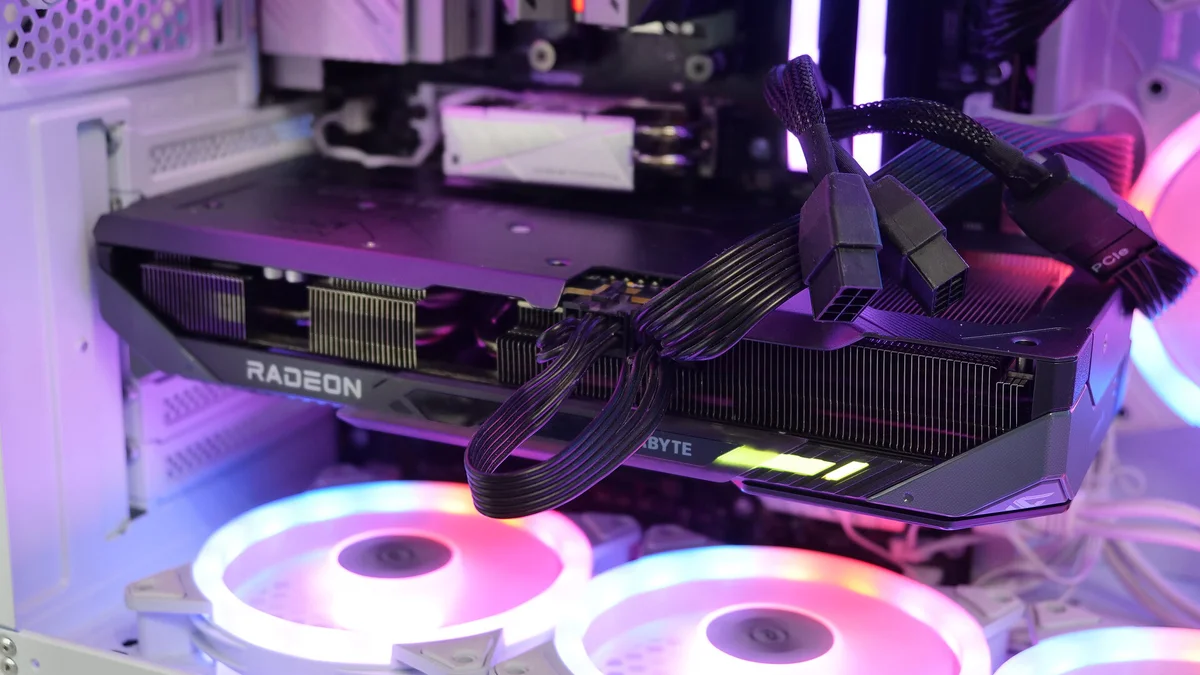
Which CPU at 1080p
1080p is where the CPU matters most with this card. The GPU finishes each frame fast, so the CPU must keep up with draw calls, game logic, and physics. A modern 6-core CPU with strong single-core speed handles this well. The Ryzen 5 9600X and Core i5-14600K are the comfortable picks here. Both keep the card fed in competitive games and AAA titles. For the highest frame rates in esports, the Ryzen 7 7800X3D is the stronger pick. Its large 3D V-Cache, extra cache memory stacked on the chip, cuts frame-time spikes in CPU-heavy games. For the Ryzen 5 7600X angle, see this: best GPU for Ryzen 5 7600X.
Which CPU at 1440p fixes the RX 9070 bottleneck
1440p is the sweet spot for the RX 9070, and it is also where CPU choice gets easier. The GPU works harder on each frame, so it sets the pace in most AAA games. Published CPU scaling tests of this card class show it going fully GPU-limited at 1440p. A Ryzen 5 9600X or Core i5-14600K still feeds the card fully. Even a Ryzen 5 7600 or Core i5-12400F keeps up in most titles at this resolution. In story-driven games, a mid-range CPU trails a flagship by only a few frames. It only grows in competitive shooters at very high refresh rates, where the CPU still sets the ceiling. On a 144 Hz or 165 Hz monitor at 1440p, a mid-range CPU is the right spend.
Which CPU at 4K
At 4K, the GPU is the limit in nearly every game. Each frame costs four times the pixels of 1080p, so the CPU waits on the GPU, not the other way round. Almost any modern 6-core CPU keeps up here, including older chips like the Ryzen 5 5600. Spending more on the CPU at 4K buys almost nothing in gaming FPS. That money is better spent on the card itself, or on a better monitor. The one exception is simulation and strategy games, where the CPU still does heavy work even at 4K. For the resolution story in full, see this: how resolution changes bottlenecks.
| Resolution | Minimum CPU that feeds it | Comfortable pick | Best for high refresh |
|---|---|---|---|
| 1080p | Ryzen 5 7600 / Core i5-12400F | Ryzen 5 9600X / Core i5-14600K | Ryzen 7 7800X3D |
| 1440p | Ryzen 5 7600 / Core i5-12400F | Ryzen 5 9600X / Core i5-14600K | Ryzen 7 7800X3D |
| 4K | Ryzen 5 5600 / Core i5-12400F | Ryzen 5 9600X | Ryzen 7 7800X3D |
FSR 4 and the CPU
FSR 4 is AMD upscaling that renders the game at a lower resolution, then rebuilds the image with machine learning. It raises the FPS number on screen, and it works on RDNA 4 cards like the RX 9070. But it does not raise the number of real frames your CPU prepares. If your CPU prepares only 60 real frames per second, FSR 4 can still show more. Yet the game feels tied to the real frame rate. So FSR 4 cannot fix a CPU bottleneck. For the upscaling comparison, see this: FSR 4 vs DLSS 4 on a CPU-limited PC. Turn on FSR 4 first, then check whether your CPU still has headroom.
Smart Access Memory and the CPU
Smart Access Memory, or SAM, is AMD's name for resizable BAR. It lets the CPU see the full GPU memory at once, instead of in small 256 MB chunks. The feature needs a Ryzen 5000 or newer CPU, a Radeon RX 6000 or newer card, and a BIOS setting switched on. AMD reports gains of up to 15 percent in selected titles with SAM on, though the gain is often much smaller. It cannot rescue a weak CPU, since the CPU still has to prepare the frames. Turn it on in the BIOS if your parts support it, since it costs nothing.
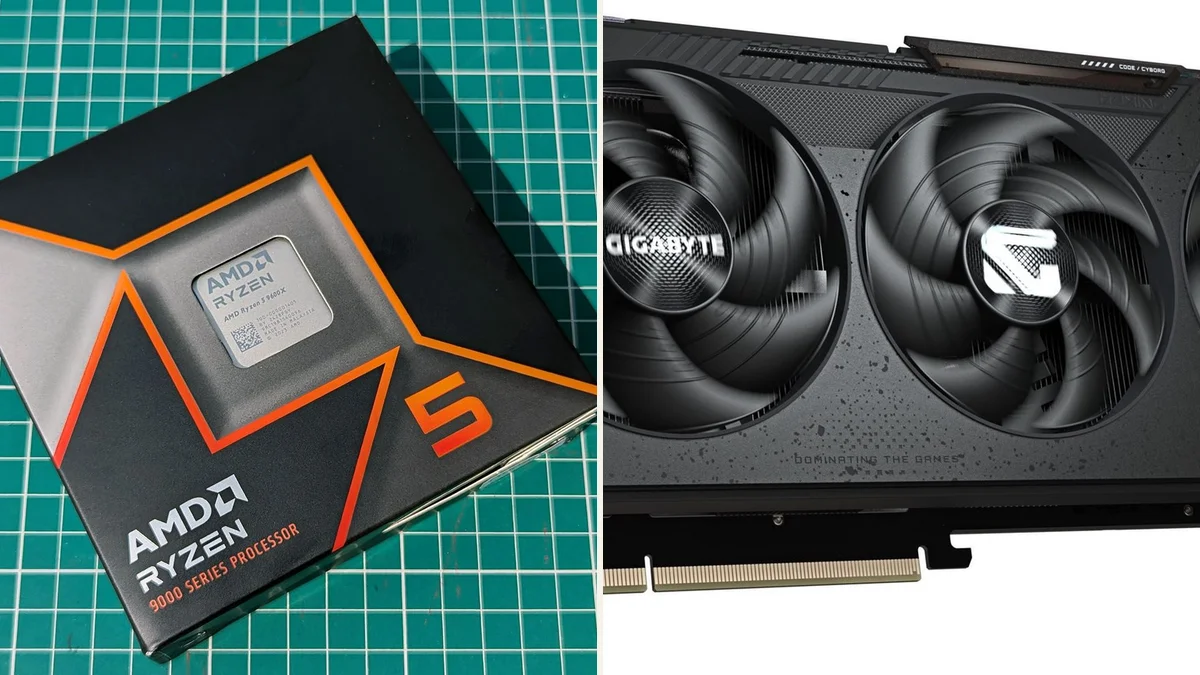
CPUs that hold the RX 9070 back
Not every CPU can feed this card, and the weak ones share a pattern. Four-core CPUs without enough threads, such as the Core i3-10100F, run out of threads in modern games. First-generation Ryzen chips, like the Ryzen 5 1600, lack the single-core speed this card needs at 1080p. Even the popular Ryzen 5 3600 starts to show its age at 1080p high refresh, though it still works at 1440p. The sign is easy to spot: GPU usage sits well below 90 percent while the CPU sits near 100 percent. A drop-in Ryzen 5 5600 on the same AM4 board often fixes it for little money.
PSU and platform notes
The RX 9070 draws 220 W, so a good 650 W power supply covers most builds with it. Pair it with a Ryzen 5 9600X and you need an AM5 board with DDR5 memory. Pair it with a Core i5-14600K and you need an LGA 1700 board, with DDR4 or DDR5. If you already own an AM4 board, a Ryzen 5 5600 or Ryzen 7 5800X3D is a cheap drop-in that feeds the card at 1440p. Do not buy a new CPU and board just for this card at 1440p. Check your pair first on the cpu bottleneck calculator to see where your own limit sits. The XT comparison is here: RX 9070 XT vs RTX 5070.
The bottom line on the RX 9070 bottleneck
The RX 9070 bottleneck is a 1080p problem, not a 1440p problem. A Ryzen 5 9600X or Core i5-14600K feeds it fully where most people play. At 4K, even a modest modern CPU keeps up. The 16 GB of VRAM is the card's real strength, since it removes the memory worry at 1440p. Spend your money on the card and the monitor first, then on the CPU only if you chase high refresh rates.
Frequently asked questions
For 1440p gaming, which CPU matches the RX 9070 best?
A Ryzen 5 9600X or Core i5-14600K is enough for the RX 9070 at 1440p in most games. The GPU sets the pace at this resolution, so a mid-range CPU feeds it fully. Even a Ryzen 5 7600 or Core i5-12400F keeps up in story-driven AAA titles. You only need a stronger chip for competitive shooters at very high refresh rates, where the CPU still sets the ceiling.
Can a Ryzen 5 9600X keep up with the RX 9070?
Yes, the Ryzen 5 9600X feeds the RX 9070 fully at 1080p and 1440p in most games. Its six fast cores and strong single-core speed match what this card needs. At 4K it has even more headroom, since the GPU becomes the limit. Only high-refresh competitive play benefits from a step up to the Ryzen 7 7800X3D, which adds large 3D V-Cache for CPU-heavy scenes.
Has the Ryzen 5 3600 run out of steam for the RX 9070?
Yes, the Ryzen 5 3600 has run out of steam for the RX 9070 at 1080p, especially at high refresh rates. Its single-core speed is well behind current chips, so the GPU waits between frames. At 1440p the gap shrinks, since the GPU works harder on each frame. A cheap fix on the same AM4 board is a Ryzen 5 5600, which restores most of the lost performance.
Is a CPU upgrade pointless for RX 9070 4K gaming?
No, the RX 9070 does not need a CPU upgrade for 4K gaming in most cases. At 4K, the GPU is the limit in nearly every game, so even a modest modern 6-core CPU keeps up. Spending more on the CPU buys almost nothing in FPS at this resolution. The only exception is simulation and strategy games, where the CPU still does heavy work even at 4K.
Will 16GB of VRAM be enough on the RX 9070 in 2026?
Yes, 16GB of VRAM is enough for the RX 9070 at 1080p, 1440p and 4K in 2026. Most games at high settings stay well under 16GB, even with high texture packs. The extra memory over 12GB cards gives you headroom for future titles and for ray tracing. The 16GB limit is rarely the issue, and a faster CPU cannot add VRAM.
Does Smart Access Memory fix a CPU bottleneck?
No, Smart Access Memory cannot fix a CPU bottleneck. It lets the CPU see the full GPU memory at once, which helps in some games, but the CPU still has to prepare every frame. AMD reports gains of up to 15 percent in selected titles. SAM helps most when the CPU and GPU are already well matched, not when the CPU is the weak link.
How this guide was prepared
This guide uses the published specifications of AMD and GamersNexus for the RX 9070. The CPU picks follow the pairing guidance of the dedicated RX 9070 guide cited in our content plan. The picks also follow the scaling behaviour those sources describe, with no measured frame rates claimed as our own. Launch prices are historical launch figures, not current street prices.
Last updated: November 12, 2026