
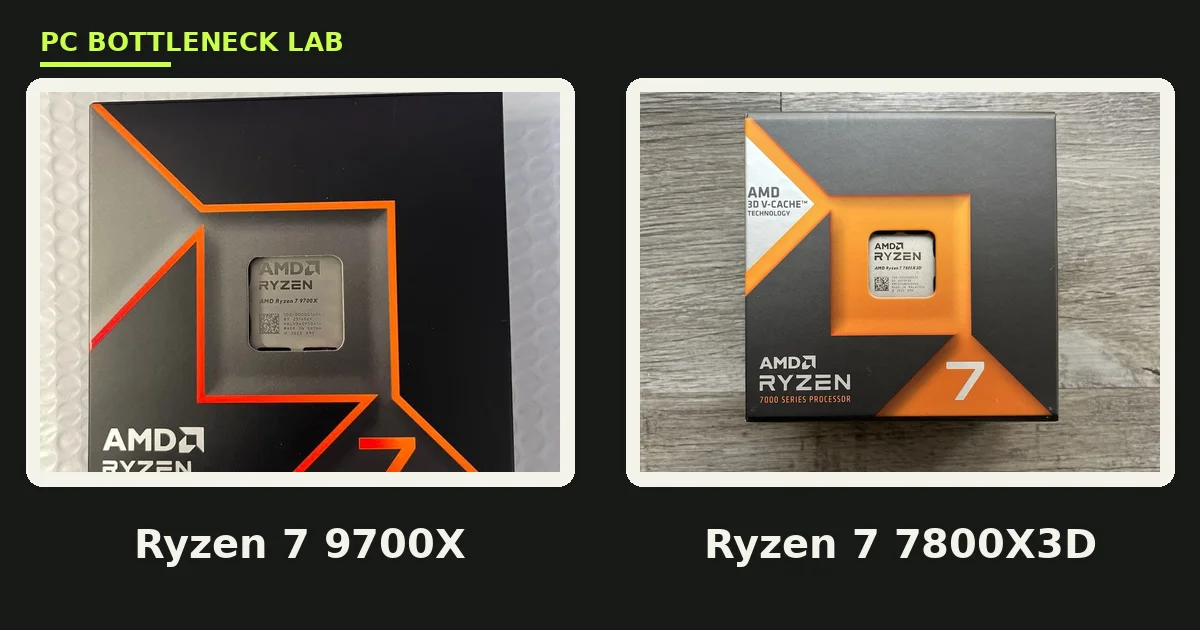
Key takeaways
- The 7800X3D leads by about 8 percent at 1080p in games, with gaps over 20 percent in a few CPU-heavy titles.
- The 9700X runs about 25 percent faster in multi-core work and 21 percent faster in single-core work.
- Both chips run 8 cores and 16 threads on the same AM5 socket with DDR5 memory.
- The 9700X draws 65W against 120W, so it runs cooler and quieter.
- Tray listings put the 9700X near $196 and the 7800X3D near $250 (as of 18 Nov 2026).
Ryzen 7 9700X vs Ryzen 7 7800X3D: the short answer
Ryzen 7 9700X vs Ryzen 7 7800X3D is a rare split: one chip wins games, the other wins work. Both chips run 8 cores and 16 threads on the same AM5 socket. The 7800X3D wins in games with its 96MB of stacked cache. Check your own pair with the free tool: pc bottleneck calculator.
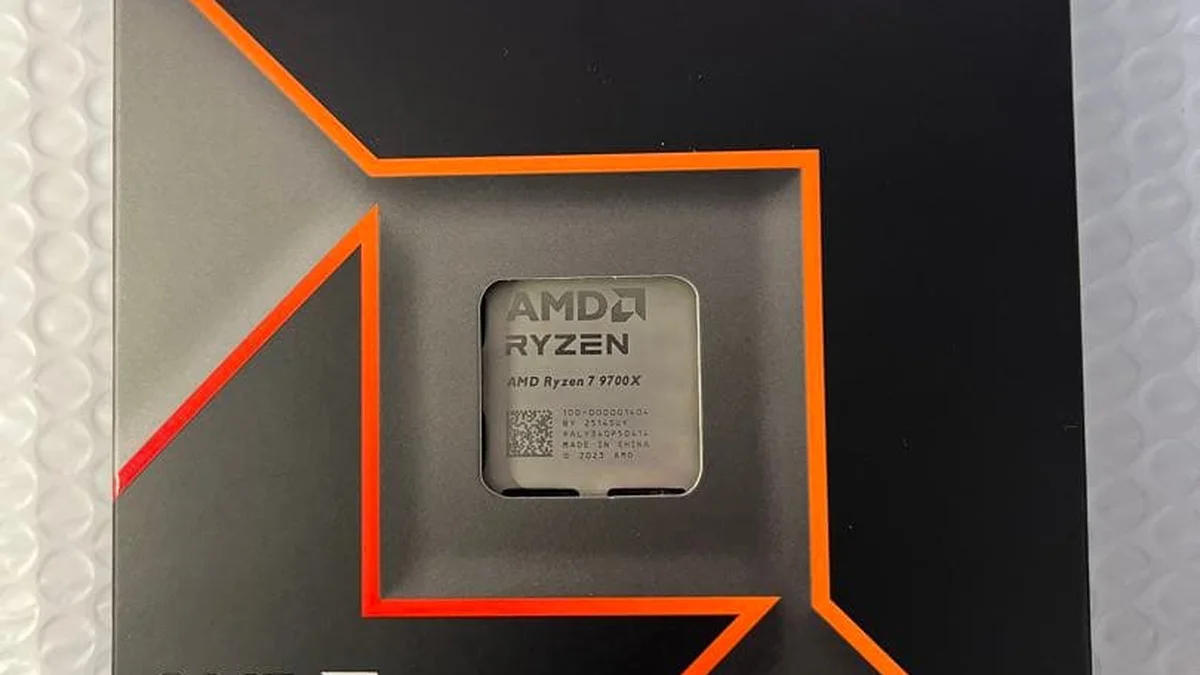
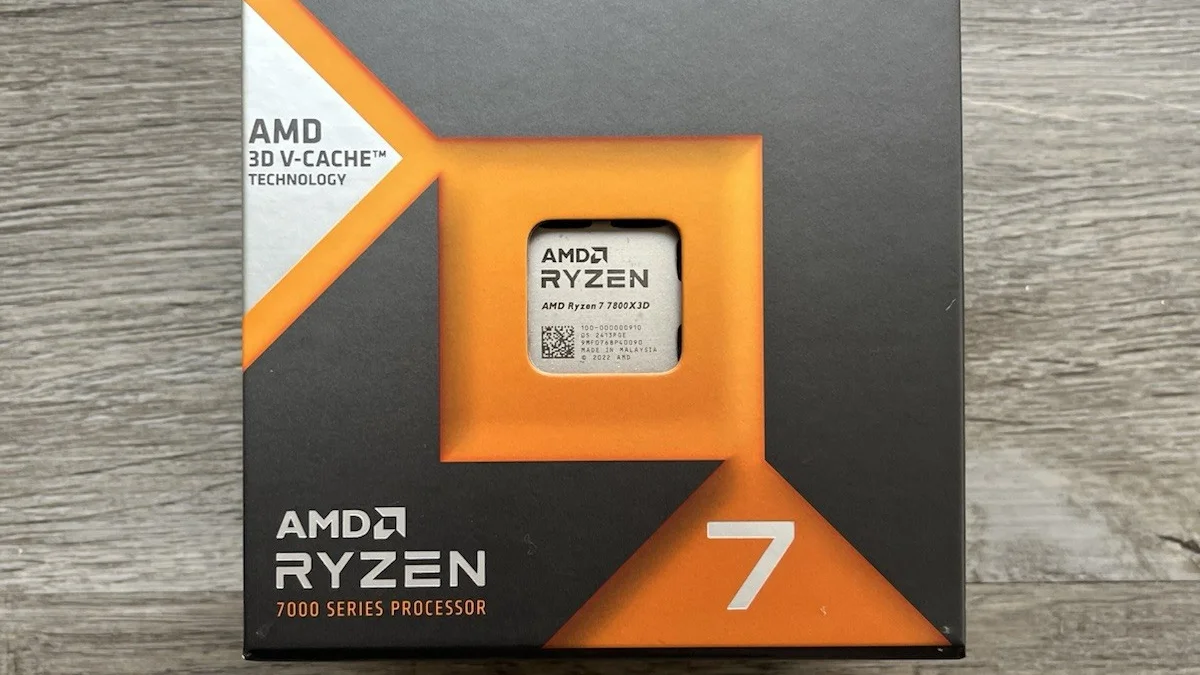
The 9700X is the newer chip, with Zen 5 cores that boost to 5.5 GHz. The 7800X3D is the older chip, with Zen 4 cores and 3D V-Cache stacked on top. Newer does not mean faster here, since the cache matters more than the clock speed in games. That twist is why this pair confuses so many buyers.
Ryzen 7 9700X vs Ryzen 7 7800X3D specs head to head
The spec sheet looks close until you reach the cache row. Both chips run 8 cores and 16 threads, with the same 8MB of L2 cache. The 9700X boosts higher and sips less power, while the 7800X3D triples the L3 cache. For the full chip specs, see the Ryzen 7 7800X3D specifications page.
| Spec | Ryzen 7 9700X | Ryzen 7 7800X3D |
|---|---|---|
| Architecture | Zen 5 | Zen 4 + 3D V-Cache |
| Cores / threads | 8 / 16 | 8 / 16 |
| Base / boost clock | 3.8 / 5.5 GHz | 4.2 / 5.0 GHz |
| L3 cache | 32MB | 96MB |
| L2 cache | 8MB | 8MB |
| TDP | 65W | 120W |
| Memory support | DDR5-5600 | DDR5-5200 |
| Socket | AM5 | AM5 |
| Overclocking | Multiplier tuning open | Multiplier locked |
| Launch | August 2024, $359 | April 2023, $449 |
The cache row decides gaming, while the clock row decides work. 3D V-Cache stacks extra cache on top of the cores, so game data sits closer to the chip. That cuts the wait for data in CPU-heavy games, which is why the older chip wins there. The 9700X answers with higher clocks and a newer core, which wins in rendering and encoding.
Gaming: where the big cache wins
Launch tests put the 7800X3D about 8 percent ahead at 1080p on average. TechPowerUp and MuyComputer both measured near 8 percent, with bigger gaps in CPU-heavy games. Baldur's Gate 3 showed the widest gap, near 23 percent in favour of the X3D chip. At 1440p and 4K, the gap shrinks to a few percent, since the graphics card sets the pace.
The pattern is clear: the lower the resolution, the more the cache matters. At 1080p high-refresh play, the CPU prepares frames fast, so cache speed shows up at once. At 4K, the GPU takes longer per frame, so the CPU has time to catch up. Buy the 7800X3D for 1080p and 1440p high-refresh play, and either chip for 4K. For the cache tech in full, see this: 3D V-Cache: 7800X3D vs 9800X3D.
Work: where the newer chip wins
The 9700X turns the tables in work tests, where clocks and cores matter more than cache. MuyComputer measured it about 21 percent faster in single-core work and 25 percent faster in multi-core work. Digital Trends found it 14 percent faster in an x265 video encode. PassMark's multi-core score also favours the 9700X, by about 8 percent.
That edge shows up in rendering, compiling, and video work, where the chip stays busy for minutes at a time. The 7800X3D still handles light work fine, yet it trails in long heavy jobs. If you game and work on one PC, weigh the split by your hours. For the 9700X with a strong AMD card, see this: Ryzen 7 9700X RX 9070 XT bottleneck.
Power, cooling and platform
The 9700X draws far less power: 65W against 120W on the 7800X3D. That gap means a smaller cooler, quieter fans, and a cheaper power supply. The 7800X3D still runs cool for its class, yet it needs a real tower cooler to hold its boost. Both chips use the AM5 socket and DDR5 memory, so either one fits the same boards.
Memory support differs a little: DDR5-5600 on the 9700X, and DDR5-5200 on the 7800X3D. In practice, both chips run well with a 6000 MT/s kit, which is the sweet spot for AM5. The 9700X also lets you tune the multiplier, while the 7800X3D keeps it locked. That freedom matters only if you enjoy tuning, so most buyers can ignore it.
Which chip for which GPU?
Match the chip to your graphics card and your monitor, not to the spec sheet. With a mid-range card at 1440p, either chip feeds the GPU fully, so buy the cheaper one. With a high-end card at 1080p high-refresh play, the 7800X3D earns its price. With a high-end card at 4K, the GPU sets the pace, so the 9700X saves money.
| GPU + resolution | Pick | Why |
|---|---|---|
| RTX 5060 at 1080p | Ryzen 7 7800X3D | High-refresh play needs the big cache |
| RX 9070 XT at 1440p | Ryzen 7 7800X3D | Fast frames need fast game data |
| RTX 5080 at 4K | Ryzen 7 9700X | The GPU sets the pace at 4K |
| RTX 5070 Ti + streaming | Ryzen 7 9700X | Work cores help background tasks |
| Mixed gaming + work | Ryzen 7 9700X | Faster rendering and encoding |
For the best GPU picks for the newer chip, see this: best GPU for Ryzen 7 9700X. The same logic works in reverse: a strong GPU with a weak CPU wastes frames. A balanced pair always beats a lopsided one, whatever the budget. For the 7800X3D with a strong Nvidia card, see this: Ryzen 7 7800X3D RTX 5070 Ti bottleneck.
The verdict
Ryzen 7 9700X vs Ryzen 7 7800X3D ends with a split by use, not by age. Buy the 7800X3D if you play at 1080p or 1440p high-refresh and want the fastest gaming chip. Buy the 9700X if you work as much as you play, or if it costs clearly less. Either way, check your pair first on the cpu gpu bottleneck calculator before you spend.
Frequently asked questions
Is the Ryzen 7 7800X3D better than the 9700X for gaming?
Yes, by about 8 percent at 1080p on average in launch tests. The 7800X3D leads in most games thanks to its 96MB of stacked cache, with gaps over 20 percent in a few CPU-heavy titles. At 1440p and 4K, the lead shrinks to a few percent. For pure gaming at high refresh rates, the 7800X3D is the better chip.
Is the Ryzen 7 9700X better than the 7800X3D for work?
Yes, by about 21 percent in single-core work and 25 percent in multi-core work, per MuyComputer. The Zen 5 cores boost to 5.5 GHz, which helps rendering, compiling, and video encoding. Digital Trends also found it 14 percent faster in an x265 encode. If you work as much as you game, the 9700X is the better pick.
Can I swap a 7800X3D for a 9700X on the same AM5 board?
Yes. Both chips use the AM5 socket, so either one fits the same board. You can swap the chip with a BIOS update at most, and keep your RAM and cooler. Check your board maker's CPU support list first, since older boards need a newer BIOS. No new platform is needed for this switch.
Which CPU is better with an RTX 5070 Ti, the 9700X or 7800X3D?
The 7800X3D is better for pure gaming with an RTX 5070 Ti, since its cache lifts frame rates at 1080p and 1440p. The 9700X is better when you also stream or edit, since its Zen 5 cores handle work faster. At 4K, both chips feed the card fully, so buy the cheaper one. Our pairing guide covers this exact match in detail.
Does the Ryzen 7 9700X run cooler than the 7800X3D?
Yes, the 9700X is rated at 65W, against 120W for the 7800X3D, so it runs cooler and quieter. A mid-range tower cooler holds its boost with ease, while the 7800X3D wants a stronger cooler. Both chips still need good case airflow, since a hot case lifts both temperatures. The 65W rating also suits small builds well.
Should I buy a Ryzen 7 9700X or a 7800X3D in 2026?
Buy the 7800X3D when gaming comes first and its price is close to the 9700X. Buy the 9700X when you also work on the PC, or when it costs clearly less. Tray listings put the 9700X near $196 and the 7800X3D near $250 (as of 18 Nov 2026). At those prices, the 9700X is the better value for mixed use.
How this guide was prepared
This guide uses the published specifications of AMD and the launch test results of TechPowerUp, MuyComputer, and Digital Trends, checked 17 Nov 2026. The GPU tiers are this guide's own reading of those sources for each resolution, and no frame rates were measured here. Prices are launch prices where stated, with tray prices dated 18 Nov 2026.
Last updated: November 18, 2026