
Key takeaways
- PC Guide tested this exact pair in-house and named the RTX 5080 the best GPU for the 9800X3D.
- At 4K ultra, the pair hit 72 FPS in Cyberpunk 2077 and 126 FPS in Indiana Jones and the Great Circle.
- With DLSS frame generation, Cyberpunk 2077 at 4K ray tracing overdrive jumped from 19 FPS to 103 FPS.
- At native 4K, the GPU sets the pace, and TechSpot found the 9800X3D matched a six-core chip there.
- The 9800X3D wins its keep at 1080p and high-refresh 1440p, where its 96MB of 3D V-Cache feeds the card fastest.
Ryzen 7 9800X3D + RTX 5080 bottleneck: the short answer
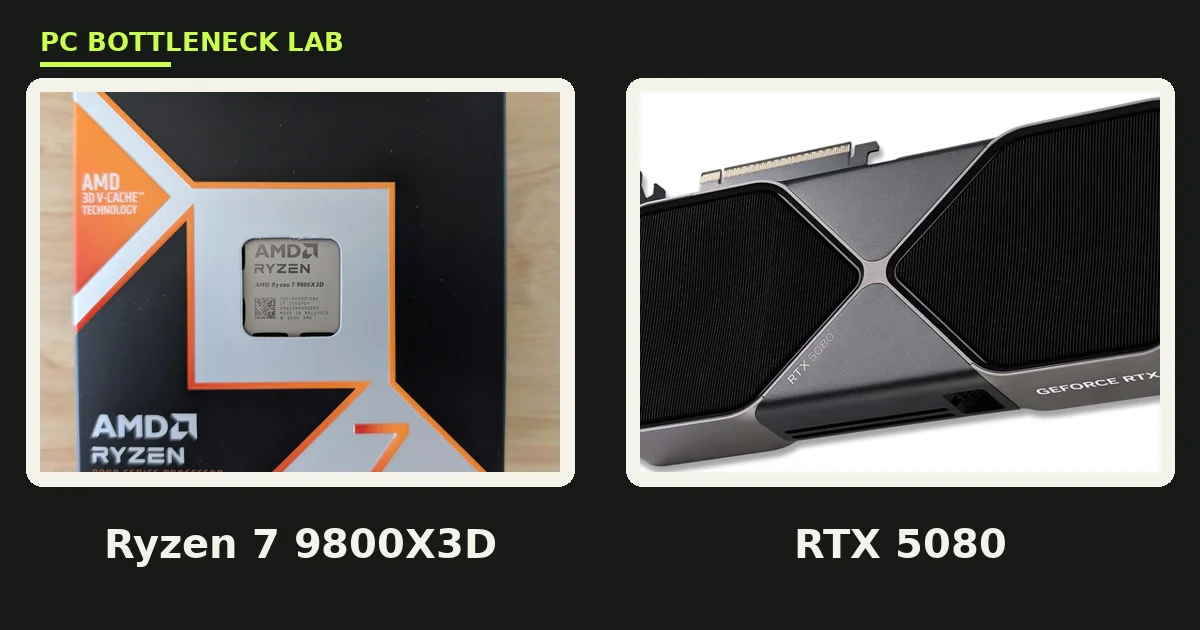
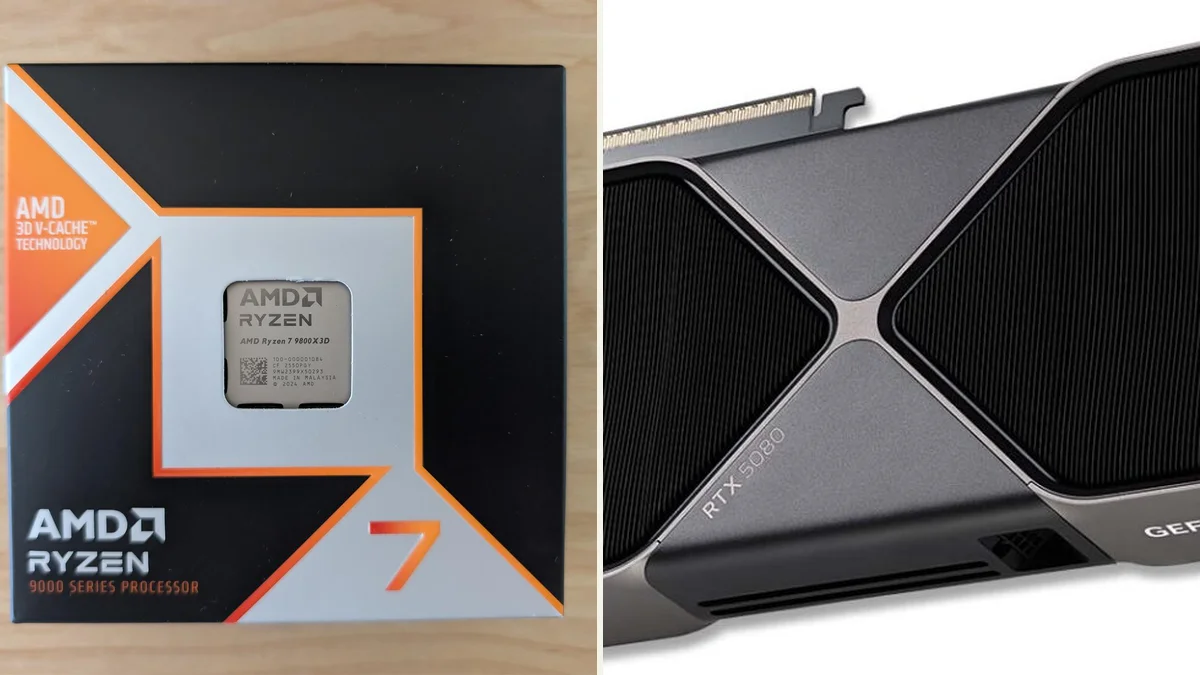
A bottleneck is the part that caps your frame rate first. For this pair at 4K, that part is the RTX 5080, and the CPU barely registers. The Ryzen 7 9800X3D is an eight-core, sixteen-thread Zen 5 chip with 96MB of L3 cache, and it was built to feed fast cards. PC Guide tested this exact pairing in-house and named the RTX 5080 the best GPU for the 9800X3D. It beat the 5070 Ti and the flagship 5090 in their ranking. Their verdict rests on real games, not on a calculator score. Check your own build with the free tool: bottleneck calculator.
| Part | Key spec | Launch |
|---|---|---|
| Ryzen 7 9800X3D | 8 cores, 16 threads, 4.7 to 5.2 GHz, 96MB L3 | November 7, 2024, $479 launch price |
| Ryzen 7 9800X3D power | 120W TDP, 162W package power limit | AM5, DDR5, PCIe 5.0, second-gen 3D V-Cache |
| GeForce RTX 5080 | 10,752 CUDA cores, 16GB GDDR7, 256-bit bus | January 30, 2025, $999 launch price |
| RTX 5080 power | 360W total graphics power, 960 GB/s bandwidth | DLSS 4 multi frame generation, PCIe 5.0 |
PC Guide tested this pair: the 4K numbers
PC Guide ran the RTX 5080 with the 9800X3D in-house, and their numbers are the core of this guide. At 4K ultra settings, Cyberpunk 2077 hit 72 FPS, while the older RTX 4080 managed 57 FPS in the same test. Indiana Jones and the Great Circle, a game that demands ray tracing, hit 126 FPS against 109 FPS for the 4080. Synthetic tests told the same story, with 21,568 points in Fire Strike Ultra against 16,135 for the 4080. Those are PC Guide in-house results, not our own tests, and they show the card working at full stretch. For the card guide in full, see this: RTX 5080 bottleneck guide.
| PC Guide in-house test | RTX 5080 + 9800X3D | RTX 4080 for comparison |
|---|---|---|
| Cyberpunk 2077, 4K ultra | 72 FPS | 57 FPS |
| Indiana Jones, 4K ray tracing | 126 FPS | 109 FPS |
| Fire Strike Ultra score | 21,568 points | 16,135 points |
| Port Royal score | 22,113 points | 16,894 points |
DLSS 4 changes the maths at 4K
Ray tracing overdrive is the one mode that breaks this pair without help. PC Guide measured 19 FPS at 4K ray tracing overdrive in Cyberpunk 2077, which is a slideshow by any standard. DLSS Performance mode plus frame generation lifted that to 103 FPS, and the highest multi frame generation setting pushed it to 183 FPS. That is a 162 percent gain from the same hardware, driven by AI frames rather than raw rendering. Multi frame generation needs a solid base frame rate to feel smooth. Use it as a booster, not as a rescue for a broken setting. For the DLSS story in full, see this: DLSS 4 multi frame generation and CPU bottleneck.
High-refresh 1440p: where the cache earns its keep
At 1440p with a 240Hz or 360Hz monitor, the 9800X3D finally shows why it costs more than a six-core chip. Its 96MB of stacked L3 cache keeps game data close to the cores, so frame times stay tight when the action gets busy. TechSpot scaling tests found the 9800X3D beat a Ryzen 5 7600X by 37 percent at 1080p with an RTX 5090. That gap shrinks as resolution rises. At native 4K, the two chips matched, since the GPU sets the pace there. The lesson is simple: buy the cache for high-refresh play, and buy the card for 4K play. For the monitor side of the choice, see this: monitor bottlenecks: 1080p 144Hz, 1440p 165Hz, 4K 60Hz.
How this differs from the 9800X3D + RTX 5070 pair
Our live 9800X3D + RTX 5070 pair page covers the value step, and this page covers the step above it. The RTX 5080 costs about 82 percent more than the 5070 at launch price. Yet it brings about 20 percent more CUDA cores and a higher boost clock. PC Guide found it traded blows with the RTX 4090 in gaming and synthetic tests, at a lower price than that flagship. The 5070 suits 1440p ultra play, while the 5080 suits 4K high-refresh play with ray tracing on. Both cards share 16GB of memory in the 5070 Ti comparison, yet the 5080 pairs that memory with more raw power. For the 5070 pair page, see this: Ryzen 7 9800X3D + RTX 5070 FPS by resolution.
Power, VRAM, and build notes
This pair needs a strong supply and a roomy case, since the card alone draws 360W. NVIDIA lists an 850W minimum system power rating for the RTX 5080, and the CPU adds up to 162W at its package limit. A quality 850W unit with a 12V-2x6 connector is the floor, and 1000W gives headroom for spikes. The 16GB of GDDR7 memory handles 4K textures well, though heavy path tracing and AI work can still press against it. Cooling is straightforward, because the 120W CPU runs cool on a mid-range tower cooler. For the best GPU list for this CPU, see this: best GPU for Ryzen 7 9800X3D.
Who should buy this Ryzen 7 9800X3D + RTX 5080 bottleneck pair, and who should not
Buy this pair if you play at 4K, or at 1440p on a 240Hz or faster monitor, and you want ray tracing on. The 9800X3D keeps 1% lows tight, and the 5080 renders the pixels, so each part covers the other weak spot. Skip it if you play at 1080p only, since a cheaper card would match the same monitor. Skip it too if your budget is tight, because the 5070 Ti gives most of the 1440p experience for less money. AM5 also leaves a long upgrade road open, so the CPU can stay through a future GPU swap. That platform life is part of the value, not an afterthought.
The bottom line on the Ryzen 7 9800X3D + RTX 5080 bottleneck
The Ryzen 7 9800X3D + RTX 5080 bottleneck stays small at 4K, which makes this the best 4K pairing for this CPU. PC Guide in-house testing backs that claim with real numbers. At 4K ultra, the card sets the pace and the CPU keeps frame times tight. DLSS 4 turns ray tracing overdrive from a slideshow into smooth play. Its only real rival is the cheaper 5070 Ti, which suits 1440p better. Run your own numbers on the CPU bottleneck calculator before you buy, and match the card to your monitor first.
Frequently asked questions
Does the Ryzen 7 9800X3D bottleneck the RTX 5080?
No, it does not bottleneck the RTX 5080 in most games at 1440p and 4K. PC Guide tested this exact pair in-house and named the 5080 the best GPU for the chip. At native 4K, the GPU sets the pace, and TechSpot found the 9800X3D matched a six-core chip there. The CPU only matters most at 1080p.
What FPS does the 9800X3D + RTX 5080 get at 4K?
PC Guide measured 72 FPS in Cyberpunk 2077 at 4K ultra, and 126 FPS in Indiana Jones and the Great Circle. Those are in-house results from their own test rig, not our own tests. Frame rates vary by game, driver, and settings, so treat them as a guide. DLSS 4 lifts both numbers further.
Is the RTX 5080 worth it over the RTX 5070 Ti for the 9800X3D?
It is worth it for 4K gaming with ray tracing, where the extra CUDA cores and bandwidth matter. PC Guide found the 5080 traded blows with the RTX 4090, while the 5070 Ti suits 1440p better. For 1440p high-refresh play, the 5070 Ti gives most of the experience for less money. Match the card to your monitor.
How does DLSS 4 help this pair at 4K?
DLSS 4 helps by generating extra frames with AI, which lifts frame rates without more raw rendering. PC Guide saw Cyberpunk 2077 at 4K ray tracing overdrive jump from 19 FPS to 103 FPS with frame generation. The highest multi frame generation setting pushed it to 183 FPS. It works best with a solid base frame rate.
Which wattage rating suits a 9800X3D and RTX 5080 build?
You need at least an 850W power supply, which is the minimum NVIDIA lists for the RTX 5080. The card draws 360W and the CPU peaks at 162W package power, so the pair alone can exceed 500W. Pick a quality 850W or 1000W unit with a 12V-2x6 connector. Cheap units risk instability under spikes.
Does 16GB GDDR7 cover 4K textures in current games?
Yes, 16GB of GDDR7 is enough for 4K gaming in most current titles. PC Guide ran 4K ultra and ray tracing tests without hitting a memory wall. Heavy path tracing, ultra texture packs, and AI workloads can press against 16GB, so watch VRAM usage in those cases. For most 4K games, it is fine.
How this guide was prepared
This guide uses the PC Guide best-GPU-for-9800X3D guide, with prices checked November 5, 2026. It includes in-house Cyberpunk 2077, Indiana Jones, Fire Strike Ultra, and Port Royal results for the RTX 5080 + 9800X3D pair. The TechSpot scaling figures come from PCBuildHelper summary of TechSpot CPU and GPU scaling tests. Specs come from AMD and NVIDIA launch material as reported by TechPowerUp and VideoCardz. FPS figures are labelled PC Guide in-house results, not our own tests.
Last updated: November 12, 2026