
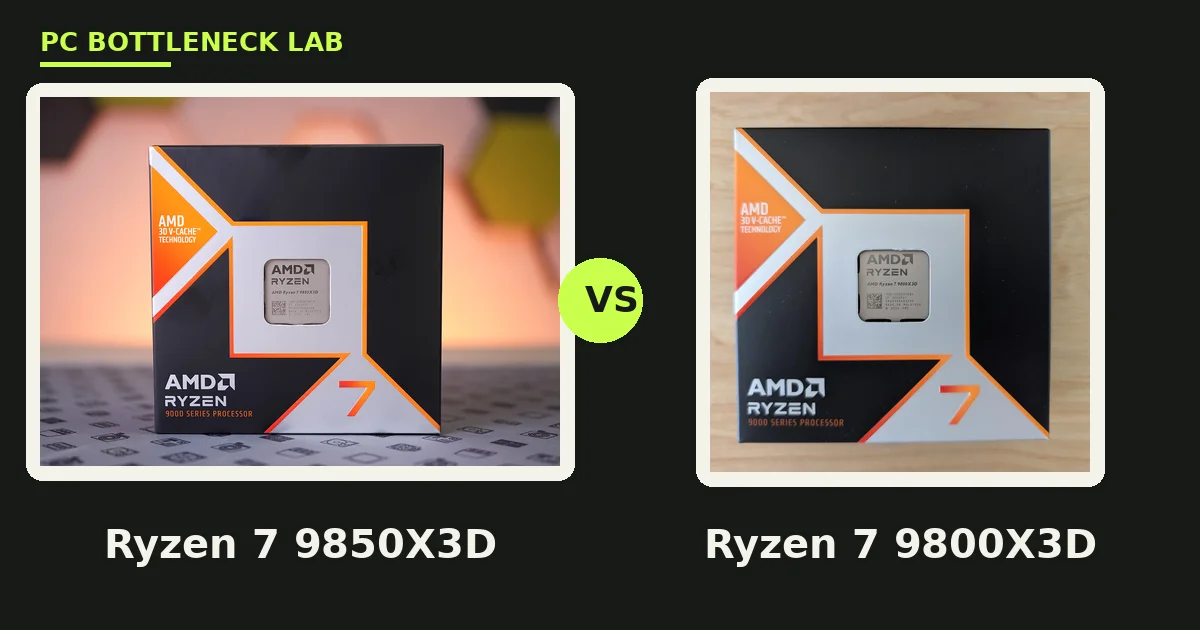
Key takeaways
- The 9850X3D is the same 8-core, 96MB chip as the 9800X3D, with 400 MHz more boost (5.6 vs 5.2 GHz).
- Tom's Hardware measured a 3.3% gaming lead at 1080p. TechSpot measured 5%. At 4K the lead drops to 0.5%.
- The 9850X3D draws around 30% more power in games, per Tom's Hardware.
- Launch prices: $499 vs $479, a $20 gap. At street prices the gap is $40 to $55.
- Verdict: buy the 9850X3D only for a new build within about $30 of the 9800X3D. Owners of either chip should not upgrade.
9850X3D vs 9800X3D specs: what actually changed
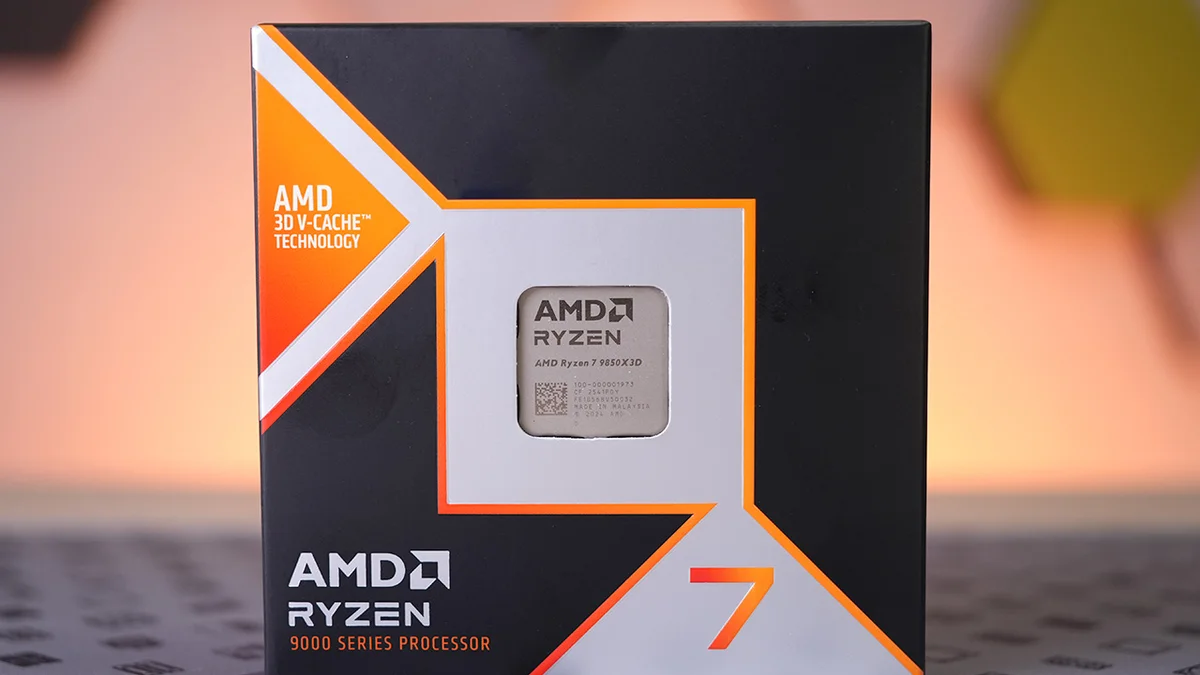
The 9850X3D is not a new architecture. It is a refined bin of the same Zen 5 silicon that powers the 9800X3D. Tom's Hardware calls it the first time AMD has re-released an X3D chip with a better bin. The only spec that moves is the boost clock, from 5.2 to 5.6 GHz. Everything else is identical. The table below is the reference spec, checked in November 2026. Both chips cost more than launch now, like every CPU in the 2026 shortage. The full price story is here: GPU prices rising November 2026: buy before Black Friday.
| Spec | Ryzen 7 9800X3D | Ryzen 7 9850X3D |
|---|---|---|
| Cores / threads | 8 / 16 | 8 / 16 |
| Base clock | 4.7 GHz | 4.7 GHz |
| Boost clock | 5.2 GHz | 5.6 GHz |
| L3 cache | 96 MB | 96 MB |
| TDP / PPT | 120W / 162W | 120W / 162W |
| Socket | AM5 | AM5 |
| Launch date | 7 November 2024 | 29 January 2026 |
| Launch price | $479 | $499 |
The gaming gap by resolution
The gaming gap is small, and it shrinks as resolution rises. Tom's Hardware measured a 3.3% lead for the 9850X3D across a 16-game suite at 1080p. TechSpot measured 5% across 14 titles with a far stronger card. In a few clock-sensitive games the lead reaches the high single digits, yet in many games there is no gain at all. At 1440p the gap falls to the low single digits, since the GPU becomes the limit. At 4K it drops to 0.5%, per TechPowerUp, where the GPU sets the frame rate. The bottleneck verdict follows the same shape. Both chips feed any current GPU at 1440p and 4K, and the extra clock only shows at 1080p high-refresh or with a 5090-class card. Check your own pair before you buy with the free tool: bottleneck calculator. For the full check method, see this: how to check for a CPU bottleneck. The slowest frames, called 1% lows, show a CPU limit first. For the frame-time story in full, see this: stuttering and frame time: 1% lows explained.
| Resolution | 9850X3D lead over 9800X3D | Source | Bottleneck verdict |
|---|---|---|---|
| 1080p | 3.3% (Tom's), 5% (TechSpot) | Tom's Hardware, TechSpot | CPU matters most here |
| 1440p | Low single digits | Tom's Hardware, Club386 | GPU is the limit |
| 4K | 0.5% | TechPowerUp | Gap nearly zero |
Which GPU pairs with each chip?
The bottleneck answer depends on the GPU. With an RTX 5060 or 5060 Ti, both chips are idle at 1080p and 1440p. The card is the limit, and the 9850X3D's clock buys nothing. With an RTX 5070 Ti at 1440p, both chips feed the card with ease. The 9850X3D's edge is a few frames at 1080p high-refresh, and nothing more. With an RTX 5080 at 1440p high-refresh, the 9850X3D is the better pick. One guide measured under 2% bottleneck with the 9800X3D here, and the 9850X3D's clock trims that further. With an RTX 5090 at 1080p, the 9850X3D's lead is real. TechSpot's 5% was measured with a 5090, and this is where the extra clock shows. At 1440p and 4K the 5090 is the limit with either chip, and the two CPUs tie. The rule is simple. Below a 5080, buy the cheaper chip. At a 5090 and 1080p, buy the faster one.
Value: which chip should you buy?
Buy the 9850X3D only for a new build, and only when it sits within about $30 of the 9800X3D. At launch the two chips sat only $20 apart, yet the street gap widened to $40 to $55 by late 2026. At that gap the small gain costs almost nothing. At a $40 to $55 street gap, the 9800X3D wins on value. It gives up 3% of the frames for far less money and power. Do not upgrade from a 9800X3D to a 9850X3D, since the gain is smaller than run-to-run benchmark variance in most games. Do not upgrade from a 7800X3D at 1440p or 4K either, since the card is the limit there. For the 7800X3D pairing, see this: best GPU for Ryzen 7 7800X3D. One more option exists. The 9800X3D matches the 9850X3D with simple PBO tuning, per one comparison, which costs nothing at all.
The bottom line on 9850X3D vs 9800X3D
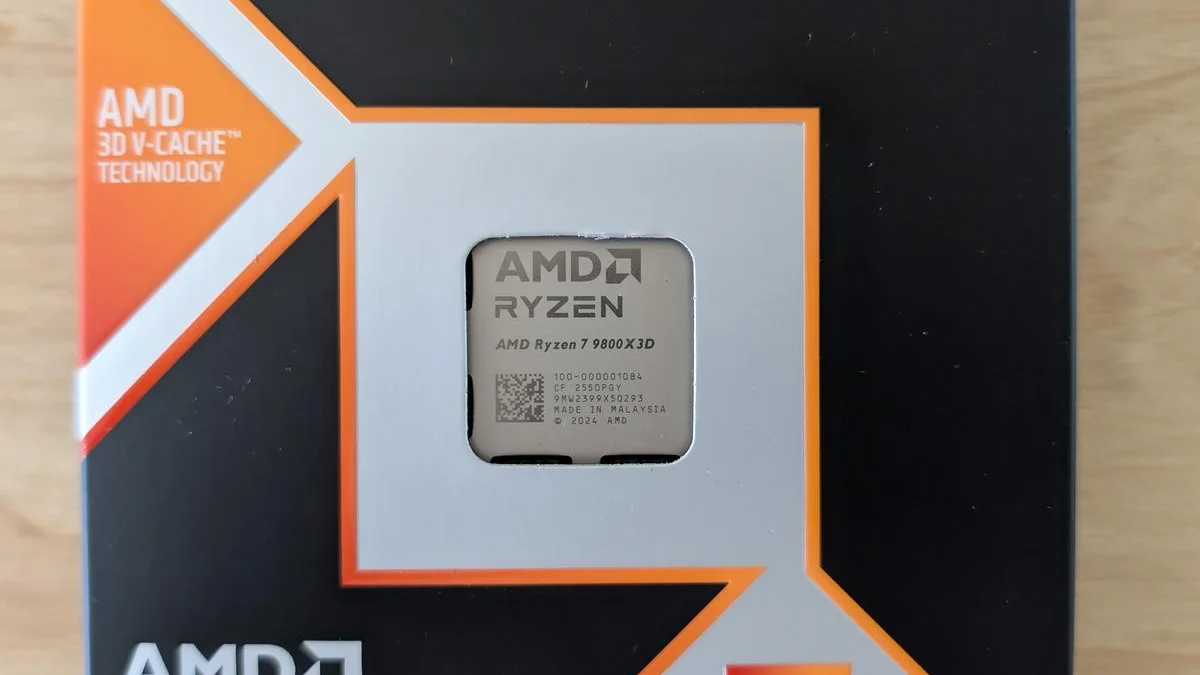
9850X3D vs 9800X3D comes down to one number. The new chip is about 3% faster in games, for $20 more at launch and 30% more power. That is a poor trade unless the street gap is tiny. Buy the 9850X3D for a new build within about $30 of the 9800X3D, and buy the 9800X3D in every other case. Check your pair first on the GPU bottleneck calculator before you spend. For the tier below these chips, see this: best CPU for RTX 5060 and 5060 Ti.
Frequently asked questions
Is the 9850X3D faster than the 9800X3D?
Yes, by a small margin. Tom's Hardware measured a 3.3% gaming lead at 1080p across 16 games, and TechSpot measured 5% across 14 titles. In a few clock-sensitive games the lead reaches the high single digits, yet in many games there is no gain at all. At 1440p and 4K the gap shrinks toward zero, since the GPU sets the frame rate.
Is the 9850X3D worth it over the 9800X3D?
Only for a new build, and only when the price gap is about $30 or less. At launch the gap was $20, yet at street prices it is $40 to $55. Spending 6% to 10% more for a 2% to 3% gaming gain is a poor trade, per Tom's Hardware. Buy the 9800X3D when the gap is wider, since it gives up almost nothing.
Should I upgrade from a 9800X3D to a 9850X3D?
No. The gain is about 3% in games at 1080p, and smaller than run-to-run benchmark variance in most games. At 1440p and 4K the gap is near zero, since the GPU is the limit. The upgrade also draws around 30% more power in games. Keep the 9800X3D, and spend the money on a better GPU or monitor instead.
Does the 9850X3D bottleneck less than the 9800X3D?
Only at 1080p high-refresh, or with a 5090-class card, where the extra 400 MHz of boost shows. At 1440p and 4K both chips feed any current GPU, and neither one bottlenecks. The bottleneck difference between the two chips is smaller than the difference between two runs of the same benchmark in most games.
How much more power does the 9850X3D use?
Tom's Hardware lists around 30% higher power consumption in games against the 9800X3D. GamersNexus measured 164W against 143W in its own test, a smaller gap yet the same direction. Both chips carry the same 120W TDP rating, yet the real draw differs. The 9850X3D needs a better cooler than the 9800X3D.
Which CPU is better for 4K gaming, 9850X3D or 9800X3D?
Neither, in practice. At 4K the lead drops to 0.5%, per TechPowerUp, since the GPU sets the frame rate. Both chips feed any current GPU at 4K, and the difference is too small to feel. Buy the cheaper chip, and put the saving into the GPU, since that is the part that decides 4K frame rate.
How this guide was prepared
This guide uses AMD's specifications for both chips, and the published tests of Tom's Hardware, TechSpot, TechPowerUp, Club386, and GamersNexus. The performance figures are attributed to those tests, not our own. The price figures are launch prices and reported street prices.
Last updated: November 11, 2026